
Steroid-Induced Osteoporosis Prevention Tool
Enter your steroid therapy details to see evidence-based recommendations for bone protection.
Why Steroids Are Harming Your Bones
When you take steroids like prednisone for conditions like asthma, rheumatoid arthritis, or lupus, you’re not just calming inflammation-you’re also quietly weakening your bones. Within just 3 to 6 months of starting daily doses of 2.5 mg or more of prednisone, bone loss begins. By the end of the first year, up to 12% of people on these drugs will suffer a vertebral fracture. That’s not rare. It’s predictable. And it’s preventable.
Glucocorticoids don’t just make you gain weight or cause mood swings. They shut down the cells that build bone (osteoblasts) and ramp up the ones that break it down (osteoclasts). The result? Bone density drops fast. People on long-term steroids face a 5 to 17 times higher risk of breaking a bone than someone not taking them. And most of them don’t even know it’s happening until they fall and hear a snap.
The Foundation: Calcium and Vitamin D
Before you even think about pills that stop bone loss, you need to make sure your body has what it needs to build bone in the first place. That means calcium and vitamin D. Not optional. Not "if you feel like it." Mandatory.
The American College of Rheumatology says everyone starting long-term steroid therapy-3 months or longer at 2.5 mg prednisone or more-should take 1,000 to 1,200 mg of calcium daily. That’s about three servings of dairy, or a combination of food and supplements. If you’re vegan or lactose intolerant, fortified plant milks, tofu, and leafy greens help, but you’ll likely still need a supplement.
Vitamin D is just as critical. Without it, your body can’t absorb calcium. The recommendation is 600 to 800 IU daily. If your blood test shows you’re deficient (under 30 ng/mL), bump it up to 800-1,000 IU. Many people on steroids are deficient because they’re indoors more, or their liver and kidneys can’t activate vitamin D properly. A simple blood test can tell you where you stand.
Skipping these two basics is like trying to build a house without bricks. No matter how strong the frame is, it won’t hold up.
Bisphosphonates: The First-Line Shield
If you’re on steroids long-term and you’re over 40, or you’ve had a fracture before, bisphosphonates are your best defense. These drugs don’t rebuild bone-they stop it from crumbling. And they’ve been doing it reliably since the late 1990s.
Alendronate (Fosamax) and risedronate (Actonel) are the most studied. Taken once a week, they’ve been shown to increase spine bone density by 3-4% in the first year, while placebo groups lose bone. In trials, they cut the risk of spinal fractures by more than half. That’s not a small win. That’s life-changing.
Here’s the catch: they have to be taken right. You swallow them on an empty stomach with a full glass of water. Then you stay upright for at least 30 minutes. No lying down. No eating. No coffee. If you don’t, you risk serious irritation to your esophagus. About 1 in 5 people have trouble with this, which is why many switch to the yearly IV version-zoledronic acid.
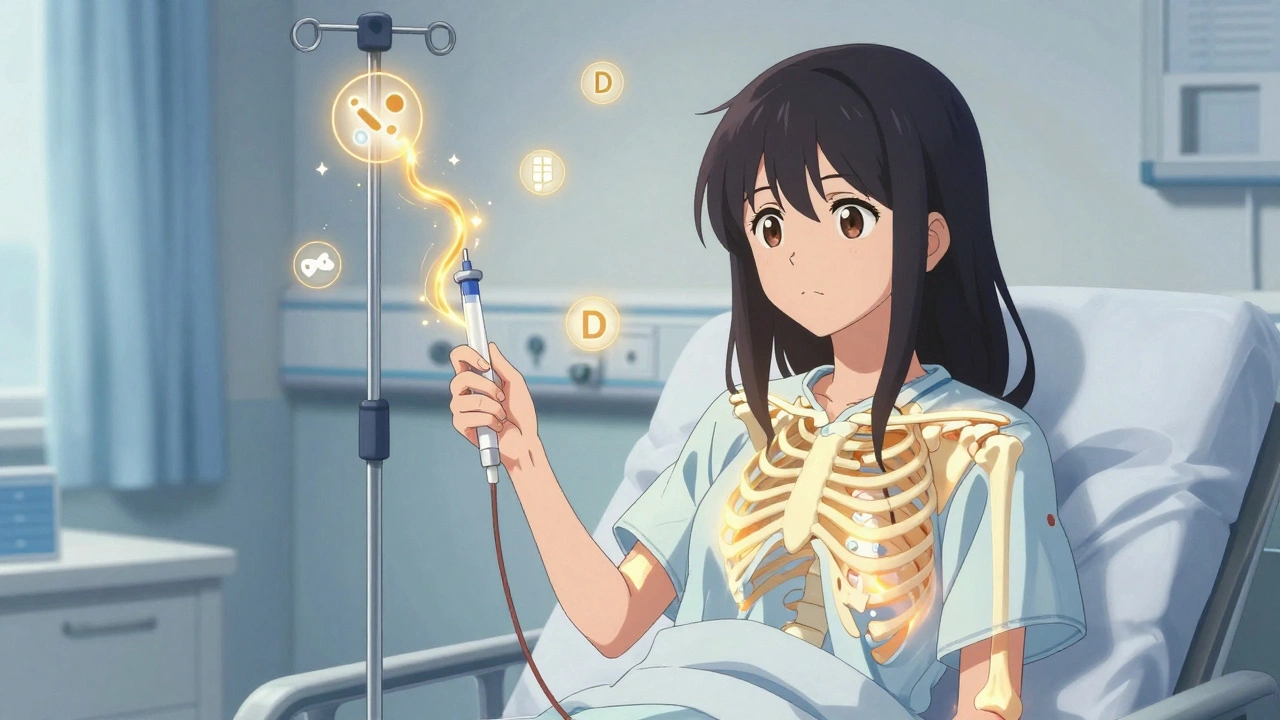
Zoledronic acid is given once a year as a 15-minute infusion. It’s more effective than oral versions at protecting the hip, which oral bisphosphonates often fail to do. And because it’s yearly, adherence jumps from 30% to over 70%. No daily pills. No fasting. Just one visit a year.
When Bisphosphonates Aren’t Enough
Not everyone responds the same. If you’re younger, have a T-score below -2.5, or already broke a bone on steroids, bisphosphonates might not be enough. That’s where teriparatide comes in.
Teriparatide (Forteo) is different. Instead of slowing bone loss, it actually tells your body to grow new bone. It’s a synthetic version of parathyroid hormone, injected daily under the skin. In a major 2007 study, only 0.6% of people on teriparatide had new spinal fractures over 18 months. Compare that to 6.1% on alendronate. The difference was dramatic.
But it’s expensive-about $2,500 a month in the U.S., compared to $250 for generic bisphosphonates. It’s also limited to two years of use. After that, you switch to a bisphosphonate or denosumab to hold onto what you gained. It’s not for everyone, but for high-risk patients, it’s the most powerful tool we have.
Denosumab (Prolia) is another option. Given as a shot every six months, it cuts spinal fracture risk by nearly 80%. It’s great for people who can’t take bisphosphonates due to kidney problems or stomach issues. But if you stop it suddenly, you can lose bone fast. So it’s not a casual choice.
Who Needs What? A Simple Guide
You don’t need to guess what’s right for you. Here’s how doctors decide:
- Everyone on steroids for 3+ months at ≥2.5 mg/day: Start calcium and vitamin D immediately.
- Age 40+, on steroids for 3+ months: Add a bisphosphonate (oral or IV).
- Under 40 with prior fracture or T-score ≤-2.5: Consider teriparatide or denosumab.
- Severe kidney disease (eGFR <30): Avoid oral bisphosphonates. Use denosumab or teriparatide.
- Can’t swallow pills or keep them down: IV zoledronic acid or denosumab shots.
There’s no one-size-fits-all. But there is a clear, evidence-backed path forward.

Monitoring and Long-Term Management
Prevention isn’t a one-time fix. You need to track your progress. A bone density scan (DXA) should be done before you start steroids, then again after 12 months. If your bone density drops more than 5% in a year, your treatment needs to change.
Also, don’t assume you’re safe after a few years. Bisphosphonates can lose effectiveness after 3-5 years. Some people need to switch to teriparatide or take a break (a "drug holiday") before restarting. Your doctor should review your plan every year.
And watch for side effects. Rare, but serious: atypical thigh fractures or jaw bone death (osteonecrosis). These are extremely uncommon-less than 1 in 10,000 people-but if you have persistent thigh or jaw pain, tell your doctor right away.
Why So Many People Are Still at Risk
Here’s the uncomfortable truth: even though guidelines have been clear since 2001, only about 1 in 5 people on long-term steroids get their bones checked. Only 19% get the right treatment within three months of starting steroids.
Doctors are busy. Patients are overwhelmed. And many don’t realize that steroids are silently breaking their bones. You can’t feel bone loss until you break something. That’s why you have to be your own advocate. Ask for a DXA scan. Ask if you need bisphosphonates. Ask about vitamin D levels.
It’s not about being paranoid. It’s about being smart. Steroids save lives. But they don’t have to steal your mobility.
What’s Next? New Treatments on the Horizon
Research is moving fast. In 2022, the FDA approved abaloparatide, a new injectable that may build bone even better than teriparatide. Studies are also testing whether using teriparatide first, then switching to zoledronic acid, gives better long-term results than either alone.
Cost is still a barrier. But as generics become more common and IV options gain traction, access is improving. The goal isn’t just to prevent fractures-it’s to keep people active, independent, and pain-free while they manage chronic illness.
Audrey Crothers
I've been on prednisone for 5 years for lupus. Started calcium + D3 right away. No fractures. Simple. Do the basics. 🙌