

When a patient with multiple sclerosis starts on a new drug, they don’t just get a prescription. They get a care plan. A nurse calls to walk them through the injection. The pharmacy tracks their labs. The billing team handles prior authorizations that take weeks. And if the brand-name drug suddenly has a generic version? That’s when things get complicated.
Specialty pharmacy isn’t your corner drugstore. It’s a high-stakes, high-cost corner of healthcare focused on complex, chronic conditions like cancer, rheumatoid arthritis, hepatitis C, and rare genetic disorders. These drugs often cost over $1,000 a month. Many are biologics-live molecules made from living cells, not chemically synthesized. Until recently, almost all of them had no generic alternatives. But that’s changing. And with change comes new challenges for pharmacists who manage these treatments daily.
Why Specialty Drugs Are Different
Traditional generics work because they’re chemically identical to brand-name pills. Take metformin or lisinopril-same active ingredient, same dose, same effect. But specialty drugs? They’re not that simple. Many are injectables or infusions. Some must be stored between 2°C and 8°C. Others require special handling to avoid degradation. A single drop of contamination can ruin a vial worth thousands.
And then there’s the cost. Specialty drugs make up just 2% of prescriptions but nearly half of all drug spending in the U.S. That’s because they’re designed for small patient populations with complex needs. A single course of treatment for a rare disease can run over $500,000. So when a generic version finally arrives, the savings aren’t just nice-they’re life-changing.
Take glatiramer acetate, used for multiple sclerosis. The brand name, Copaxone, cost about $78,000 a year. When the generic hit the market in 2021, the price dropped to around $45,000. That’s a 42% reduction. For patients on fixed incomes, that’s the difference between staying on treatment and stopping.
Generics in Specialty Pharmacy: Not as Simple as It Seems
In a typical community pharmacy, switching to a generic is routine. Nine out of ten prescriptions are filled with generics. But in specialty pharmacy, the rate is often below 10%. Why? Because for most specialty drugs, there simply isn’t a generic yet.
But when one does appear, it’s not a straightforward swap. Pharmacists now face a new set of decisions. Is this generic bioequivalent? Does the patient have an excipient allergy? Has the patient been stabilized on the brand? What if the generic looks different?
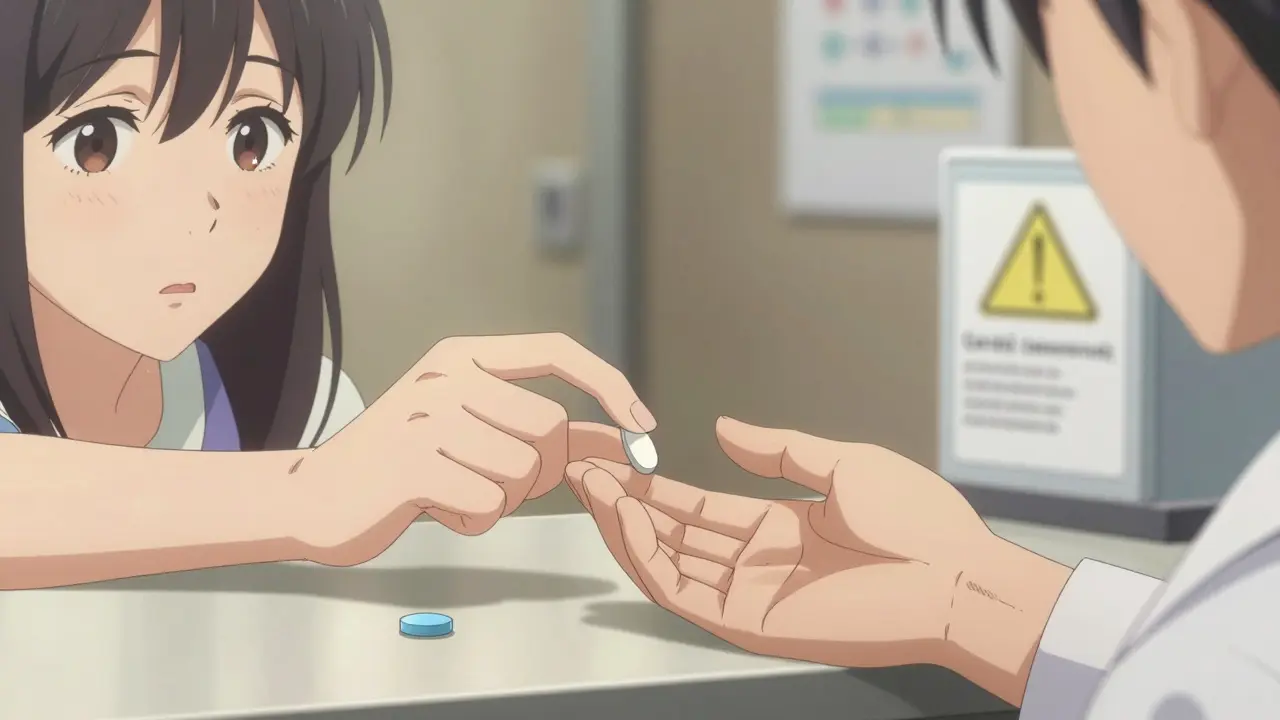
Appearance matters more than people think. A patient on levothyroxine might switch from a white oval pill to a blue round one. Same active ingredient. Same dose. But the color, shape, and markings changed. The patient calls the pharmacy in panic: “Did they give me the wrong drug?” That’s not a pharmacy error-it’s a counseling gap. Specialty pharmacists now spend more time explaining that generics can look different without being different in effect.
And then there’s the narrow therapeutic index (NTI). These are drugs where a tiny change in blood level can cause harm. Levothyroxine, warfarin, phenytoin-switching between generic manufacturers can lead to unstable levels, even if the FDA says they’re bioequivalent. A 2022 study in U.S. Pharmacist found that many clinicians prefer to keep patients on the same generic manufacturer once stabilized. Some won’t switch at all.
The Biosimilar Revolution
Then came biosimilars. These aren’t generics. They’re not exact copies. They’re highly similar versions of biologic drugs, made from living cells, not chemicals. The FDA approved its first biosimilar in 2015. By December 2023, that number had grown to 35.
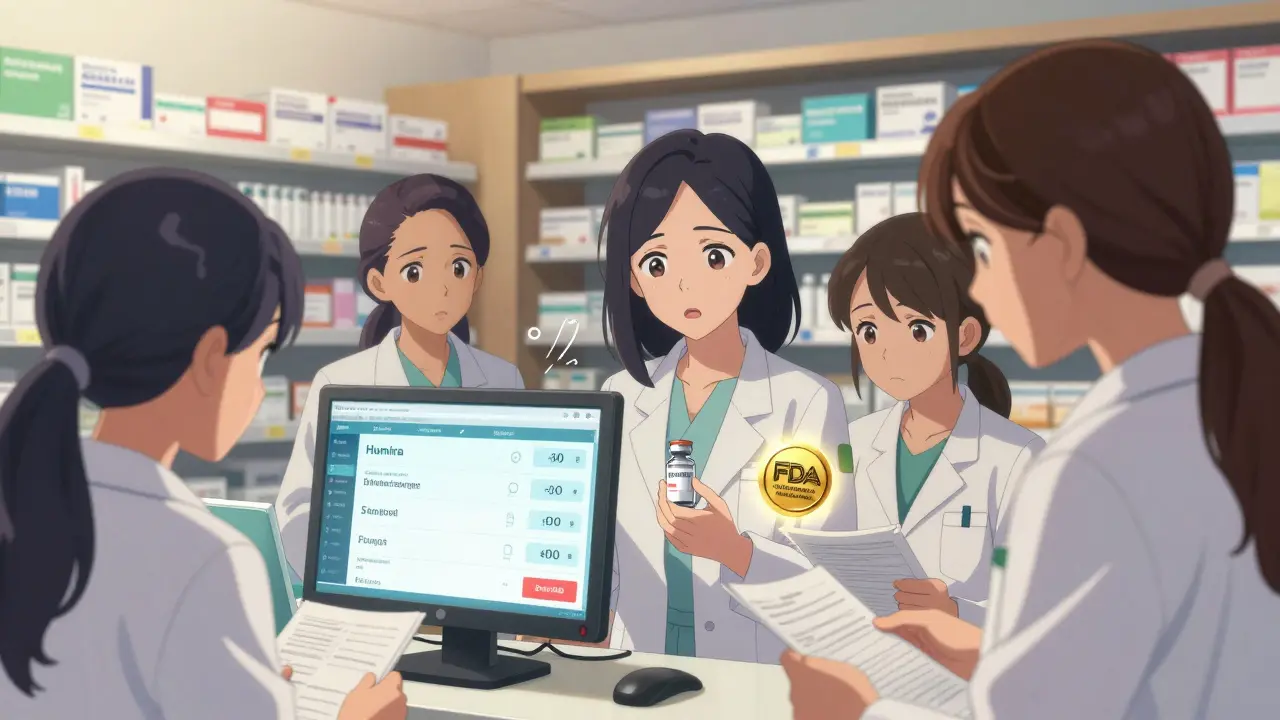
Biosimilars are the future of specialty pharmacy. Humira, the top-selling drug in the world for years, finally lost its patent exclusivity in 2023. Dozens of biosimilars flooded the market. Prices dropped by 30% to 50% almost overnight.
But here’s the catch: biosimilars don’t always substitute automatically. Unlike traditional generics, which can be swapped at the pharmacy counter, biosimilars need explicit prescriber approval unless they’re labeled “interchangeable.” The first interchangeable biosimilar, Semglee (for insulin glargine), was approved in 2021. That means a pharmacist can swap it for the brand without contacting the doctor.
Still, many PBMs (Pharmacy Benefit Managers) don’t make it easy. They often place biosimilars on higher cost tiers, forcing patients to pay more out of pocket. Some require step therapy-try the brand first, then the biosimilar. That’s backwards. It’s like making someone drive a gas-guzzler before letting them try a hybrid.
PBM Policies Are Making Things Harder
Pharmacists in specialty pharmacy are caught between two forces: the need to cut costs and the reality of how PBMs operate. PBMs measure something called the Generic Dispensing Ratio (GDR). It’s a metric that tracks how often generics are used. But here’s the problem: if a specialty pharmacy doesn’t have any generics to dispense-because the drug has no generic version-they’re still penalized for not meeting GDR targets.
One pharmacy in Ohio was fined $12,000 last year because their GDR was 62%, even though 90% of their drugs had no generic alternative. The PBM didn’t care. They just wanted the number to go up.
And reimbursement? Many PBMs pay less than what the pharmacy paid to buy the drug. That’s called “negative spread.” In specialty pharmacy, where margins are razor-thin, that’s not just bad business-it’s unsustainable.
Managing the Supply Chain Nightmare
Another hidden challenge? Multiple manufacturers. For a single generic drug, there might be five different makers. Each has different packaging, different labeling, different lot numbers. Some are imported. Some have recalls. Some have delays.
Specialty pharmacies need to track which manufacturer supplied each batch. Why? Because if a patient has a reaction, they need to know which version they got. If a patient is stable on one generic and the pharmacy switches to another without telling them? That’s a risk.
McKesson Medical-Surgical recommends using a single, reliable distributor for generics in specialty settings. Why? Because juggling five suppliers means five sets of paperwork, five delivery schedules, five chances for something to go wrong.
What Pharmacists Need to Do Differently
Specialty pharmacists aren’t just filling prescriptions. They’re care coordinators. Here’s what that looks like in practice:
- Build a substitution policy-Define when and how generics or biosimilars are used. For NTI drugs, require prescriber approval.
- Track excipient allergies-Some generics use different fillers. A patient allergic to lactose or dyes might react. Document this in the system.
- Standardize packaging-Use the same strength, same bottle size, same labeling across all manufacturers for each drug. Reduces confusion.
- Monitor after switch-For drugs like levothyroxine or warfarin, check blood levels 4-6 weeks after switching to a new generic or biosimilar.
- Train staff on counseling-Patients need to hear: “This looks different, but it works the same. If you feel worse, call us.”
And don’t forget education. Patients still think “generic = cheaper = worse.” A 2022 survey in Specialty Pharmacy Times found that 78% of pharmacy staff spent significant time calming patient fears about generics. That’s not a side task-it’s core to the job.
The Road Ahead
The number of specialty drugs with generics or biosimilars will only grow. Humira’s biosimilars are just the start. More than 20 blockbuster biologics are set to lose patent protection by 2030. That means more savings. More options. More complexity.
Specialty pharmacies that adapt will thrive. Those that treat generics like they’re just another pill on the shelf won’t survive. The future belongs to pharmacies that combine clinical expertise with supply chain savvy. That means better systems, better training, and better conversations with patients.
It’s not about choosing between brand and generic. It’s about choosing the right option for the right patient at the right time. And that’s where the real skill of specialty pharmacy lies.
Can a specialty pharmacy automatically substitute a biosimilar for a brand-name drug?
Only if the biosimilar is labeled "interchangeable" by the FDA. As of 2025, only a handful of biosimilars have this status, like Semglee for insulin. For non-interchangeable biosimilars, the prescriber must specifically authorize the switch. Pharmacists cannot substitute them without a new prescription.
Why do some patients feel worse after switching to a generic specialty drug?
While generics are required to be bioequivalent, small differences in inactive ingredients or manufacturing can affect how the body absorbs the drug-especially for narrow therapeutic index drugs like levothyroxine or warfarin. Some patients report new side effects or reduced effectiveness after switching manufacturers, even if the FDA approves both versions. This is why many clinicians prefer to keep patients on the same manufacturer once stabilized.
Do all specialty drugs have generic versions?
No. Most specialty drugs, especially biologics, still don’t have generics. Biologics are complex molecules made from living cells, making exact copies nearly impossible. Instead, biosimilars-highly similar but not identical versions-are the alternative. As of 2025, only about 15% of specialty drugs have any form of generic or biosimilar alternative. That number is growing, but slowly.
How do pharmacy benefit managers (PBMs) affect generic use in specialty pharmacy?
PBMs often penalize specialty pharmacies for not meeting high Generic Dispensing Ratio (GDR) targets-even when no generics exist for the drugs they dispense. They may also reimburse below cost, create restrictive formularies, or place biosimilars on higher cost tiers, making them harder for patients to access. These policies can discourage appropriate generic use and create financial strain on pharmacies.
What’s the biggest mistake pharmacists make with specialty generics?
Assuming bioequivalence means interchangeability. Just because the FDA says two drugs are bioequivalent doesn’t mean they’re identical in effect for every patient. The biggest mistake is switching patients without counseling them, tracking outcomes, or documenting the change. For high-risk drugs, a switch should be intentional, monitored, and patient-centered-not just a cost-saving move.
wendy parrales fong
It’s wild how much goes into just switching a pill. I had a friend on a specialty drug for MS, and when the generic came out, her insurance forced the switch. She panicked because the pill looked different - same science, totally different feeling. Turns out, she was fine, but it took weeks of calls and reassurance. This isn’t just pharmacy work - it’s therapy with a clipboard.