
Most people don’t know they have subclinical hyperthyroidism until their doctor mentions it during a routine blood test. No weight loss. No shaky hands. No sudden heat intolerance. Just a low TSH number on a lab report-and everything else normal. But that quiet abnormality isn’t harmless. Especially if you’re over 65. Especially if you have high blood pressure or a history of heart problems.
What Exactly Is Subclinical Hyperthyroidism?
Subclinical hyperthyroidism means your thyroid is slightly overactive, but not enough to push your free T4 or T3 levels out of range. Your body still makes the right amount of thyroid hormones, but your pituitary gland stops producing as much TSH-the hormone that tells your thyroid to slow down. Doctors define it as a TSH level below 0.45 mIU/L, with normal free T4 and T3. It’s not overt disease. But it’s not nothing either.
This condition shows up most often in older adults. About 4 to 8% of the general population has it. But in people over 75? That number jumps to nearly 1 in 6. The most common causes are toxic nodular goiter-where one or more nodules in the thyroid start producing excess hormone-and too much thyroid medication in people being treated for hypothyroidism. In younger people, it’s often linked to Graves’ disease, though that usually progresses to overt hyperthyroidism.
Because symptoms are so subtle or absent, it’s almost always found by accident. Someone gets a blood test for something else-a cholesterol check, a pre-op screen, a yearly physical-and the TSH comes back low. That’s when the real questions start: Should I do something? Or just watch it?
Why the Heart Is the Biggest Concern
Here’s the hard truth: subclinical hyperthyroidism doesn’t just quietly sit there. It puts stress on your heart. And that stress builds up over time.
Studies tracking thousands of people over a decade show clear patterns. If your TSH is below 0.1 mIU/L, your risk of atrial fibrillation-the most common serious heart rhythm problem in older adults-more than doubles. One large study found a hazard ratio of 2.54. That’s not a small increase. It’s the same as having a major risk factor like uncontrolled high blood pressure.
And it’s not just rhythm. Your heart muscle thickens. The left ventricle gets stiffer. Diastolic function-the way your heart fills with blood between beats-gets worse. Heart rate variability drops, meaning your autonomic nervous system is out of balance. Your sympathetic system (fight-or-flight) is stuck on high, while your vagal tone (rest-and-digest) fades. This isn’t just theory. These changes show up on echocardiograms and Holter monitors in people with persistent low TSH.
Heart failure risk also climbs. People with TSH below 0.1 mIU/L have nearly double the chance of developing heart failure over 10 years compared to those with normal thyroid function. For those with TSH between 0.1 and 0.44 mIU/L, the risk is still elevated-about 60% higher. And these risks aren’t just for people with existing heart disease. They apply to anyone, even if they feel perfectly fine.
One study of 71 older adults with subclinical hyperthyroidism found that those with TSH below 0.1 had nearly five times the risk of heart failure compared to healthy controls. That’s not a coincidence. That’s biology.
Bones, Brain, and Other Hidden Risks
The heart isn’t the only organ at risk. Your bones pay a price too. When TSH is suppressed below 0.1 mIU/L, bone turnover increases. Bone density drops. The risk of fractures-especially hip and spine fractures-goes up by more than double in some studies. That’s a major concern for older women and men with osteoporosis or low bone mass.
Cognitive effects are less clear, but emerging data suggest subtle changes. A 2016 study in the Journal of the American Geriatrics Society found that elderly patients with long-term subclinical hyperthyroidism had slightly worse performance on tests of executive function-things like planning, attention, and mental flexibility. Not dementia. Not memory loss. But enough to notice if you’re paying close attention.
Quality of life? Most people with mild cases (TSH 0.1-0.44) report no symptoms. But once heart issues start-palpitations, shortness of breath, fatigue-that changes. And once you’re on beta-blockers to manage the heart rate, you might feel tired or sluggish. So even if you start out feeling fine, the condition can quietly erode how you feel day to day.

When Should You Treat It?
This is where things get messy. There’s no one-size-fits-all answer. Guidelines from the American Thyroid Association and the American Academy of Family Physicians agree on one thing: don’t treat everyone. But they also agree that some people need action.
If your TSH is below 0.1 mIU/L, treatment is strongly considered-especially if you’re over 65, have heart disease, osteoporosis, or are postmenopausal. In these cases, the risks of doing nothing outweigh the risks of treatment. Options include radioactive iodine to destroy overactive thyroid tissue, surgery to remove nodules, or reducing thyroid hormone medication if you’re on it for hypothyroidism.
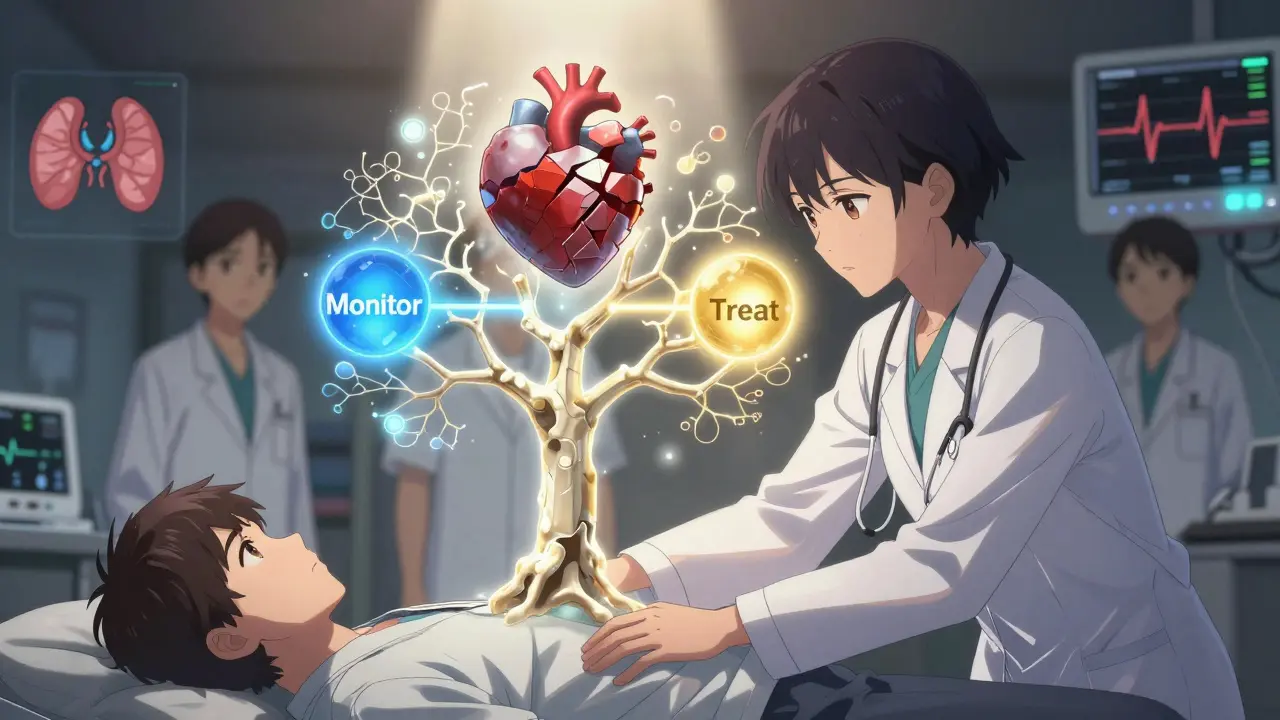
If your TSH is between 0.1 and 0.44 mIU/L, treatment isn’t automatic. You need other red flags: palpitations, high blood pressure, left ventricular hypertrophy on echo, low bone density, or symptoms like anxiety or unexplained weight loss. In younger, healthy people with no heart issues, doctors often just monitor.
Many doctors start with beta-blockers like propranolol or atenolol. They don’t fix the thyroid problem, but they calm the heart. They lower heart rate, reduce palpitations, and can even help reverse some of the thickening of the heart muscle. It’s a bridge-giving you time to decide if you need more aggressive treatment.
But here’s the catch: treating subclinical hyperthyroidism can lead to hypothyroidism. And that comes with its own risks-higher cholesterol, fatigue, depression, and even increased heart disease risk in older adults. So doctors don’t rush into radioactive iodine or surgery unless the benefits clearly outweigh the downsides.
Monitoring: How Often Should You Get Tested?
Monitoring isn’t optional. It’s essential.
If your TSH is below 0.1 mIU/L, get tested every 3 to 6 months. You need to track whether it’s getting worse, staying the same, or improving. A repeat test after 3 months confirms it’s not a temporary blip-like from illness or stress.
If your TSH is between 0.1 and 0.44 mIU/L and you have no heart or bone issues, annual testing is usually enough. But if you develop new symptoms-a racing heart, unexplained weight loss, or worsening osteoporosis-get retested sooner.
Don’t forget the full picture. A thyroid ultrasound can show if nodules are growing. A bone density scan (DEXA) helps assess fracture risk. An ECG or 24-hour Holter monitor can catch early signs of atrial fibrillation.
What’s Changing in 2026?
Guidelines aren’t set in stone. They’re evolving.
The DEPOSIT study, tracking 5,000 people over 65 with subclinical hyperthyroidism across Europe, is wrapping up in 2026. Its results could shift how we treat this condition. The THAMES trial in the U.S., led by Dr. Angela Leung, is looking at whether treating TSH below 0.1 actually reduces heart attacks and strokes. Early data suggest yes.
The American Heart Association’s 2022 statement called for more randomized trials. Right now, most evidence comes from observational studies. We need proof that treating early saves lives-not just improves lab numbers.
One thing is already clear: mild TSH suppression (0.1-0.44) in someone with existing heart disease may need more attention than we’ve given it. A 2021 review in the European Heart Journal suggested that even this level may be harmful if the heart is already stressed.
What Should You Do Now?
If you’ve been told you have subclinical hyperthyroidism:
- Don’t panic. You’re not in crisis.
- Do get a full cardiac workup: ECG, echo, and possibly a Holter monitor.
- Ask for a bone density test if you’re over 60 or postmenopausal.
- Review all medications-especially thyroid hormone doses-with your doctor.
- If your TSH is below 0.1, discuss treatment options. Don’t wait for symptoms.
- If your TSH is 0.1-0.44 and you’re young and healthy, monitor yearly-but stay alert for new symptoms.
Subclinical hyperthyroidism isn’t a diagnosis you ignore. It’s one you manage-with care, with monitoring, and with a clear understanding of your personal risk. Your thyroid may be whispering. But your heart is listening.
Can subclinical hyperthyroidism go away on its own?
Yes, in some cases. If it’s caused by a temporary issue like thyroiditis or medication changes, TSH levels may return to normal without treatment. But if it’s due to a toxic nodule or Graves’ disease, it rarely resolves on its own. Persistent suppression-especially below 0.1 mIU/L-usually requires intervention.
Does subclinical hyperthyroidism cause weight loss?
Not usually. Unlike overt hyperthyroidism, where weight loss, heat intolerance, and tremors are common, subclinical cases often have no symptoms at all. Weight loss only happens if TSH drops very low and thyroid hormone levels begin to rise into the high-normal range. Most people don’t lose weight until the condition becomes overt.
Is radioactive iodine safe for older adults?
Yes, when used appropriately. Radioactive iodine is a common and effective treatment for toxic nodules in older adults. It’s non-surgical and well-tolerated. The main risk is developing hypothyroidism afterward, which is easily managed with daily thyroid hormone replacement. For patients with heart disease, this is often safer than leaving the condition untreated.
Can I take supplements to fix subclinical hyperthyroidism?
No. There are no proven supplements that normalize TSH or treat subclinical hyperthyroidism. Some products claim to support thyroid health, but they can interfere with lab tests or even worsen the condition. Avoid iodine supplements unless specifically prescribed. The only proven treatments are medication adjustment, radioactive iodine, or surgery.
How does subclinical hyperthyroidism differ from overt hyperthyroidism?
The key difference is hormone levels. In overt hyperthyroidism, free T4 and/or T3 are above the normal range. In subclinical, they’re normal-only TSH is low. Overt cases cause clear symptoms: weight loss, rapid heartbeat, anxiety, tremors. Subclinical often causes no symptoms at all. But the long-term heart and bone risks are similar, especially when TSH is very low.
Next steps: If you’re over 60 and have a low TSH, schedule a cardiac evaluation. If you’re on thyroid medication, ask your doctor to review your dose. And if you’ve been told it’s “not serious”-ask for data. Ask for numbers. Ask for a plan. Because in medicine, silence isn’t always safety.
vivek kumar
Let’s cut through the noise: subclinical hyperthyroidism isn’t ‘mild’-it’s a slow-burn cardiac time bomb. TSH below 0.1 isn’t a lab quirk, it’s a biological red flag. The data doesn’t lie: doubled atrial fibrillation risk, stiffened ventricles, suppressed heart rate variability. If you’re over 65 and this is sitting on your report, you’re not ‘fine.’ You’re one missed echo away from a stroke or heart failure. Stop being polite about it. Get the ultrasound. Get the Holter. Stop waiting for symptoms. By then, it’s too late.