

Imagine waking up and suddenly finding that your legs don't follow your brain's orders. You try to take a step, but your balance is gone, and your walk looks more like a stumble. This is the daily reality for people living with Ataxia is a neurological sign characterized by the loss of full control of bodily movements. It isn't a single disease but rather a symptom of dysfunction in the cerebellum or the neural pathways that connect it to the rest of the body. While the idea of "losing coordination" sounds simple, for the person experiencing it, it affects everything from speaking and swallowing to the simple act of buttoning a shirt.
The good news is that while many forms of ataxia are progressive or caused by permanent damage, the brain is remarkably adaptable. Through targeted ataxia rehabilitation, people can reclaim a significant amount of their independence. A 2021 Cochrane review of over 1,800 patients showed that the right multidisciplinary approach can improve quality of life metrics by 25% to 40%. The goal isn't necessarily to "cure" the underlying neurological issue-since many types lack disease-modifying therapies-but to rewire the way the body moves and balances.
Key Takeaways for Recovery
- Task-Specific Training: Practicing real-world movements is 35% more effective than generic physical therapy.
- Multidisciplinary Care: Combining physical, occupational, and speech therapy yields the best functional outcomes.
- Consistency Over Intensity: Long-term maintenance is vital, especially for hereditary forms where gains can be temporary.
- Specialized Expertise: Seek therapists with specific cerebellar training (like CRED certification) to avoid exercises that may actually worsen symptoms.
Understanding the Root Cause: Why Coordination Fails
To fix the movement, you have to understand the machinery. The Cerebellum is the region of the brain responsible for coordinating voluntary movements, balance, and posture. It houses about 69 billion neurons-roughly 80% of the brain's total-despite being a small fraction of the brain's volume. When this area is damaged, the "timing" of your muscles goes off. This results in the classic signs: gait instability (seen in 98% of cases), slurred speech known as dysarthria (92%), and involuntary eye movements (85%).
Not all ataxia is the same, and the cause dictates the rehab path. Hereditary Ataxia is a group of genetic disorders, such as Friedreich's ataxia, that cause progressive degeneration of the nervous system. These usually appear between ages 5 and 25. On the other hand, Acquired Ataxia is coordination loss resulting from external factors like stroke, trauma, or vitamin B12 deficiency. Acquired cases are more common-accounting for 70% of clinical cases-and often show much higher recovery rates, with some patients seeing 40-60% functional recovery after a stroke.
The Modern Roadmap for Neurological Rehabilitation
Rehabilitation for ataxia isn't about lifting weights; it's about precision and repetition. The most successful programs move through three distinct phases over a 12-week period to safely challenge the nervous system.
Phase 1: Static Balance (Weeks 1-4)
This phase focuses on keeping the body still. Therapists use "dual-task" challenges, such as asking a patient to maintain balance while naming different types of fruit. This forces the brain to manage balance subconsciously while the conscious mind is occupied.
Phase 2: Dynamic Gait (Weeks 5-8)
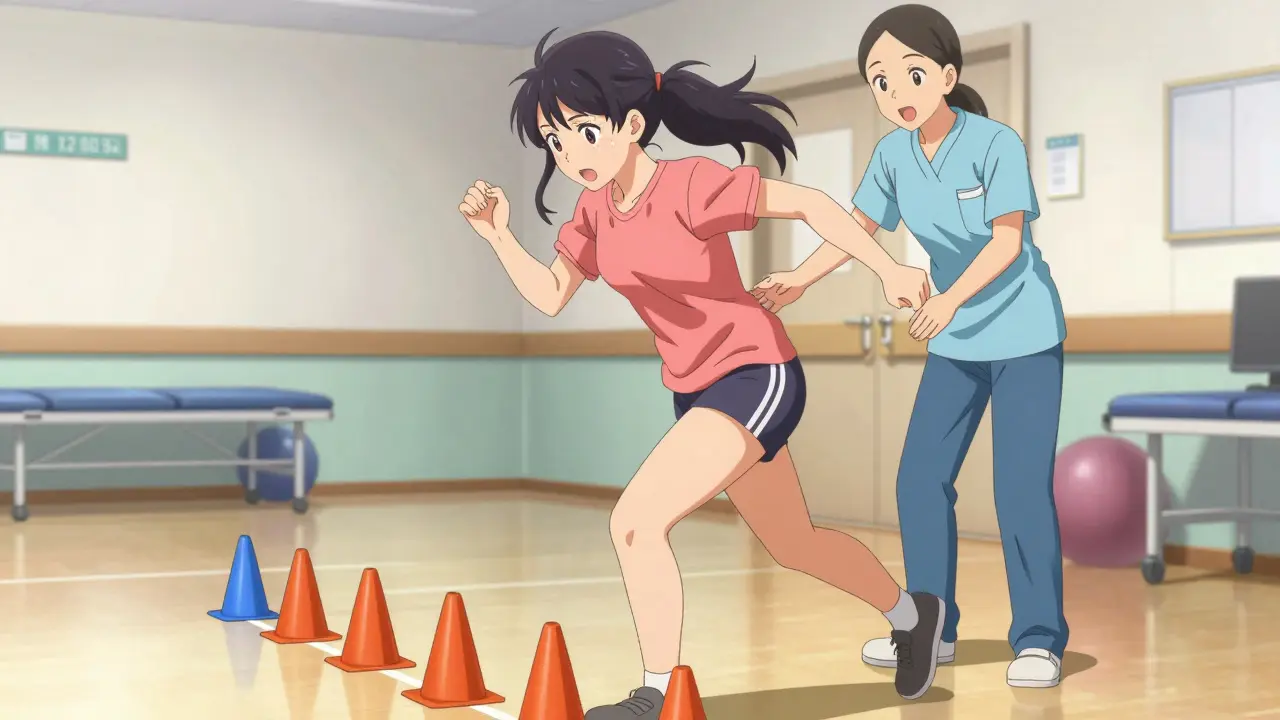
Once stability is improved, the focus shifts to moving. This involves obstacle negotiation-walking around cones or stepping over small hurdles. The goal is to teach the brain how to adjust the center of gravity in real-time.
Phase 3: Community Ambulation (Weeks 9-12)
The final stage mimics the real world. Patients practice navigating crowded environments or walking on uneven surfaces like grass or gravel. This phase is critical for reducing fall frequency, which some patients report dropping from over three falls a week to less than one.
| Method | Primary Benefit | Efficacy/Outcome | Best For... |
|---|---|---|---|
| Task-Specific Training | Functional Independence | 35% higher improvement than generic PT | Daily living skills (dressing, eating) |
| Computerized Posturography | Measurable Balance Gain | Avg. 8.2 point Berg Scale increase | Severe balance deficits |
| Aquatic Therapy | Reduced Gravity Impact | High patient satisfaction (4.3/5) | Early-stage mobility |
| Robotics-Assisted Gait | Repetitive Motion | Low (only 12% meaningful gain) | General stroke recovery (not cerebellar) |
The Danger of "Generic" Physical Therapy
Here is a warning: not all physical therapy is created equal. Many patients report a frustrating experience where generic PT actually made their symptoms worse. This happens because standard therapy for stroke patients-like Constraint-Induced Movement Therapy (CIMT)-is designed for hemiparesis (weakness on one side). However, ataxia is a problem of coordination, not strength. In fact, CIMT can worsen symptoms in 68% of ataxia patients because it pushes the nervous system in a way that conflicts with cerebellar pathophysiology.
This is why seeking a specialized therapist is non-negotiable. Programs like the CRED (Cerebellar Rehabilitation and Evaluation Dynamics) certification ensure the provider understands the difference between a "weak muscle" and a "miscoordinated signal." A patient on Reddit recently shared that switching to a CRED-certified therapist helped them drop their SARA Score (Scale for the Assessment and Rating of Ataxia) from 18 down to 12 in just ten weeks. The SARA score is the gold standard for measuring progress, yet surprisingly, only 37% of clinics actually use it routinely.
Tech-Driven Recovery: Beyond the Clinic
We are entering an era where rehab isn't limited to the clinic. New tools are helping bridge the gap for those who can't afford $250-per-session private care or live in rural areas. The FDA recently cleared the Cerebello wearable device, which uses neuromodulation to suppress tremors, leading to a 32% improvement in upper limb function.
For those with access to high-end centers, the CAREN (Computer Assisted Rehabilitation Environment) system uses virtual reality to create immersive environments. This increases patient engagement by 28% compared to traditional exercises. Even for those at home, wearable sensors like APDM Opal can track 17 different gait parameters, giving therapists a data-driven map of how a patient is actually moving in their own living room rather than just in a sanitized clinic setting.

Navigating the Financial and Emotional Hurdles
Let's be honest: the biggest barrier to recovery often isn't the biology, but the bureaucracy. Many patients face insurance denials after an arbitrary limit of 20 visits, even when their neurologist recommends 40. With average out-of-pocket costs reaching $2,450 annually, the financial burden is real, especially for the 31% of patients with household incomes below $50,000.
Beyond the money, there is the "cognitive-affective" side of the disease. Dr. Jeremy Schmahmann of Harvard notes that 70% of patients experience executive function deficits. This means that the part of the brain that helps you plan and stay organized is also affected. If you find yourself struggling to stick to your home exercise program, it might not be a lack of will-it might be your brain struggling with the planning process. Involving a caregiver to help schedule and track exercises can be the difference between failure and a 30-45% improvement in SARA scores.
Can ataxia ever be completely reversed?
It depends on the cause. Acquired ataxia caused by vitamin B12 deficiency or toxic exposure can sometimes resolve completely if the underlying cause is treated. However, hereditary forms like Friedreich's ataxia are progressive, meaning rehab focuses on slowing the decline and maintaining function rather than a full reversal.
How often should I do rehabilitation exercises?
Standard intensive protocols usually involve 3 to 5 sessions per week, each lasting 60 to 90 minutes. For those doing home-based programs, consistency is key. High-intensity, repetitive task practice is what leads to the most significant changes in brain plasticity.
What is the SARA score and why does it matter?
The Scale for the Assessment and Rating of Ataxia (SARA) is a clinical tool used to quantify the severity of ataxia. It tracks gait, stance, speech, and limb coordination. It matters because it provides an objective metric to see if a specific therapy is actually working or if the approach needs to be adjusted.
Why is aquatic therapy recommended for ataxia?
Water provides buoyancy, which reduces the impact of gravity on the body. This allows patients to practice balance and movement with a lower risk of falling, providing a "safe space" to build confidence and strength before transitioning to land-based training.
Does a generic physical therapist know how to treat ataxia?
Not necessarily. Only about 22% of community clinic therapists have specific ataxia training. Because ataxia requires a different approach than general muscle weakness or hemiparesis, it is highly recommended to find a provider with specialized neurorehabilitation or CRED certification.
Next Steps for Your Journey
If you are just starting your recovery, your first move should be to request a baseline SARA score from your neurologist. This gives you a starting point to measure success. Next, audit your therapy: if you are doing generic gym exercises (like leg lifts or basic weights) without task-specific goals (like practicing getting out of a car), ask your therapist about "task-oriented training."
For those in rural areas, don't let geography stop you. Telehealth is now used by nearly 45% of rural ataxia patients, with high satisfaction rates. Even a remote consultation with a specialized neuro-physiotherapist can help you design a home program that is safe and effective, preventing the "trial-and-error" delays that can otherwise set patients back by six to twelve months.
Nikolai Mortenson
Hello, my name is Nikolai Mortenson, and I am a dedicated expert in the field of pharmaceuticals. I have spent years studying and researching various medications and their effects on the human body. My passion for understanding diseases and their treatments has led me to become a prolific writer on these topics. I aim to educate and inform people about the importance of proper medication usage, as well as the latest advancements in medical research. I often discuss dietary supplements and their role in health maintenance. Through my work, I hope to contribute to a healthier and more informed society. My wife Abigail and our two children, Felix and Mabel, are my biggest supporters. In my free time, I enjoy gardening, hiking and, of course, writing. Our Golden Retriever, Oscar, usually keeps me company during these activities. I reside in the beautiful city of Melbourne, Australia.
view all postsWrite a comment