

Red Yeast Rice & Statin Interaction Checker
This tool helps you understand the risks of combining red yeast rice with statins. Red yeast rice contains monacolin K, which is identical to lovastatin. Combining both can increase your risk of severe muscle damage and other complications.
Check Your Combination
If you're taking a statin for high cholesterol and thinking about adding red yeast rice to boost results, stop. You might be putting yourself at serious risk - and you're not alone. Thousands of people do this every year, believing they're just switching from a "chemical" drug to a "natural" alternative. But here's the truth: red yeast rice isn't a gentle herb. It's essentially a hidden statin. And mixing it with a prescribed statin? That's like double-dosing on the same drug - and it can land you in the hospital.
What Exactly Is Red Yeast Rice?
Red yeast rice isn't some new fad. It's been used in China for over a thousand years, mostly for digestion and circulation. But in 1979, a Japanese scientist made a breakthrough: he isolated a compound from it called monacolin K. That compound? It's chemically identical to lovastatin - the first statin ever made. Since then, red yeast rice has been marketed as a "natural" way to lower cholesterol. But "natural" doesn't mean safe, especially when it acts exactly like a prescription drug.
Here's the kicker: red yeast rice supplements don't list lovastatin on the label. Instead, they say "red yeast rice extract" or "monacolins." But that's what you're getting - pure, unregulated lovastatin. The amount varies wildly. Some products contain almost none. Others pack in up to 34 mg of monacolin K per gram. That's more than double the highest dose of prescription lovastatin. And because it's sold as a supplement, the FDA doesn't require manufacturers to prove it's safe or consistent.
How It Works - And Why It's a Problem
Both statins and red yeast rice work the same way: they block HMG-CoA reductase, the enzyme your liver uses to make cholesterol. Lower that enzyme's activity, and your LDL (bad) cholesterol drops. Studies show red yeast rice can cut LDL by 21-30% - similar to a low-dose statin. That sounds great… until you realize you're already taking a statin.
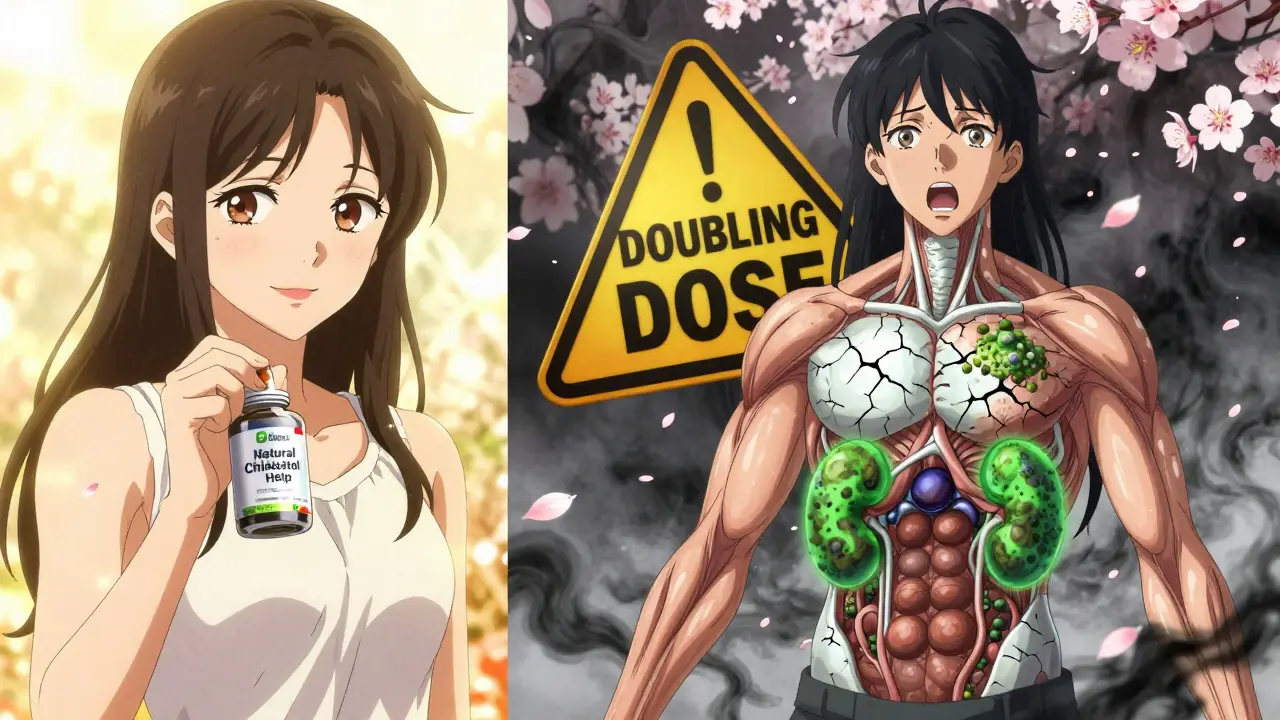
When you combine the two, you're not doubling your cholesterol-lowering power. You're doubling your risk of side effects. The most dangerous? Muscle damage. A condition called rhabdomyolysis can occur when muscle cells break down and leak into the bloodstream. This can fry your kidneys, cause organ failure, and even kill. The FDA has recorded 127 serious cases of this between 2018 and 2022 - nearly all involving people who took red yeast rice alongside statins.
One Reddit user, "CardioWarrior99," shared his story: after taking 1,200 mg of red yeast rice daily while on 20 mg of atorvastatin, his muscle enzyme levels (CK) spiked to 18,500 U/L. Normal is under 200. He ended up in the ICU. His doctor said he was lucky to survive.
The Hidden Dangers: Contamination and Unreliable Labels
Even if you avoid statins and only take red yeast rice alone, you're not out of the woods. Many products are contaminated with citrinin - a toxic mold byproduct that can damage your kidneys. A 2017 report from the European Food Safety Authority found citrinin in 25-30% of red yeast rice supplements. And labeling? Forget accuracy. ConsumerLab.com tested 50 popular brands in 2022. Only 30% matched what was on the label. Some had no monacolin K at all. Others had 10 times more than claimed.
There's also the issue of drug interactions. Red yeast rice is processed by the same liver enzyme (CYP3A4) that breaks down grapefruit juice, certain antibiotics, and antifungal meds. If you're taking any of those, your body can't clear the monacolin K fast enough. That means higher blood levels - and higher risk. Even a single grapefruit in the morning can turn a "safe" dose into a dangerous one.
Who Should Avoid It - And Who Might Benefit
There's no gray area here: if you're on a statin, don't take red yeast rice. Period. The American Heart Association, Mayo Clinic, and Johns Hopkins all say the same thing: avoid the combination. The risk of muscle damage, liver injury, and kidney failure is too high.
But what if you can't tolerate statins? About 1 in 5 people develop muscle pain or weakness from statins. For them, red yeast rice might be an option - but only if used alone, under a doctor's supervision. A 2017 study found that 60% of statin-intolerant patients could handle a low dose of red yeast rice (1,800 mg daily, providing about 3 mg of monacolin K). Their LDL dropped by 25-30%, and side effects were mild.
Here's the catch: you need to know exactly what you're getting. Only USP-verified products (about 15% of the market) guarantee consistent monacolin K levels and no citrinin contamination. Look for the USP Verified mark on the bottle. And start low - 600 mg daily. Wait 8-12 weeks. Get your CK and liver enzymes tested. Then, and only then, consider adjusting the dose.
What the Experts Say
Dr. JoAnn Manson from Harvard put it bluntly: "The variable monacolin content makes red yeast rice products pharmacologically unpredictable compared to regulated pharmaceuticals." That's why major medical groups - the American College of Cardiology, the American Heart Association - don't recommend it as a first-line treatment. They see it as a risky gamble.
On the other hand, some researchers argue that with proper standardization, red yeast rice could be a legitimate option for statin-intolerant patients. A 2023 JAMA Cardiology study showed it reduced heart attacks and strokes by 47% in people who couldn't take statins - but again, none of those patients were taking statins at the same time.
The bottom line? If you're not on a statin and have mild high cholesterol, red yeast rice might help - if you use a verified product. But if you're already on a statin? You're playing Russian roulette with your muscles and kidneys.
What to Do Instead
There are safer, proven alternatives if statins don't work for you:
- Ezetimibe: A pill that blocks cholesterol absorption in the gut. Often used with statins, but safe on its own.
- PCSK9 inhibitors: Injectable drugs that lower LDL by 50-60%. Expensive, but very effective.
- Prescription niacin: Can raise good cholesterol, though it has its own side effects.
- Lifestyle changes: Diet (fiber-rich, low saturated fat), exercise, and weight loss can lower LDL by 10-20% on their own.
None of these carry the same unpredictable risks as red yeast rice. And unlike supplements, they're regulated, tested, and monitored.
Final Advice
Don't assume "natural" means safe. Red yeast rice is not a vitamin. It's a potent drug with variable strength and hidden toxins. If you're taking a statin, stop using red yeast rice immediately. Tell your doctor what you're taking - even if you think it's "just a supplement." Many patients don't mention supplements, and that's how dangerous interactions slip through.
If you're considering red yeast rice because you can't tolerate statins, talk to your doctor. Get tested. Use only USP-verified products. And never combine it with other cholesterol meds. Your muscles - and your kidneys - will thank you.
Is red yeast rice the same as statins?
Yes, in active ingredient. Red yeast rice contains monacolin K, which is chemically identical to lovastatin - the first statin drug. While it's sold as a supplement, it works exactly like a prescription statin by blocking the same enzyme in the liver. The difference is that statins are FDA-approved with precise dosing, while red yeast rice varies wildly in potency and can contain harmful contaminants.
Can I take red yeast rice if I have muscle pain from statins?
No - not unless you stop the statin first. If you're still taking a statin, adding red yeast rice doubles your risk of severe muscle damage (rhabdomyolysis). If muscle pain from statins is your issue, talk to your doctor about switching to ezetimibe, PCSK9 inhibitors, or a lower statin dose. Red yeast rice is not a safe alternative when combined with statins. It may help if used alone, but only under medical supervision and with a verified product.
Are all red yeast rice supplements the same?
Absolutely not. A 2022 ConsumerLab.com analysis found only 30% of products matched their label claims. Some had no monacolin K. Others had 10 times more than stated. Many also contained citrinin, a toxic mold linked to kidney damage. Only products with the USP Verified mark have been independently tested for potency, purity, and safety. Stick to those - and avoid anything labeled "natural" or "pure" without third-party verification.
How long does it take for red yeast rice to work?
It takes 8 to 12 weeks to see full cholesterol-lowering effects. Unlike statins, which often show results in 2-4 weeks, red yeast rice works more slowly because of variable absorption and potency. Don't expect quick results. Always get a lipid panel done after 12 weeks to measure effectiveness. And never increase the dose before then - higher doses increase risk without guaranteed benefit.
Can I drink grapefruit juice while taking red yeast rice?
No. Grapefruit juice interferes with the liver enzyme (CYP3A4) that breaks down monacolin K. This causes higher levels of the compound to build up in your blood - increasing the risk of muscle damage and liver toxicity. This interaction is the same as with statins. Avoid grapefruit juice, Seville oranges, and products containing them if you're taking red yeast rice. The same rule applies to certain antibiotics, antifungals, and some heart medications.
John Cena
Been taking red yeast rice for years, never knew it was basically lovastatin. My doc never mentioned it either. Guess I’m lucky I never combined it with my statin. Still, this post scared the hell out of me. Going to check my bottle right now.