
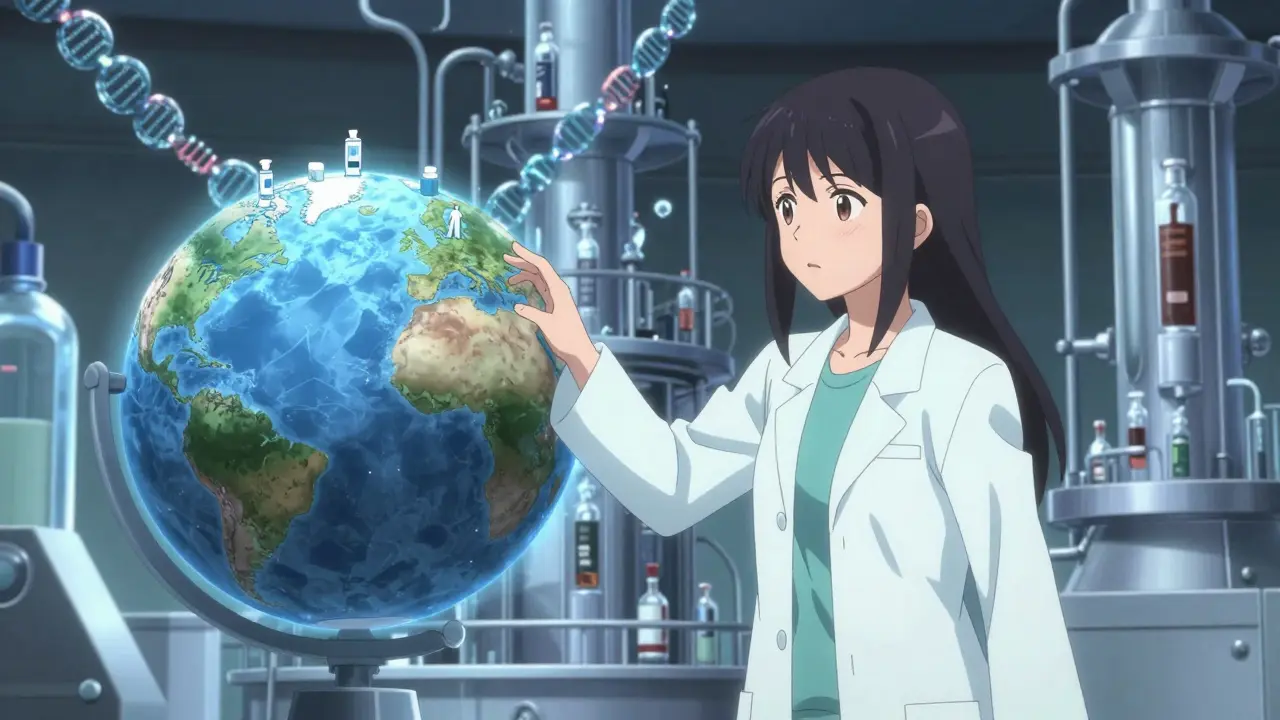
There’s no such thing as a generic vaccine - not really. You won’t find a cheaper, identical version of Pfizer’s COVID-19 shot on a pharmacy shelf like you can with aspirin or metformin. That’s not because no one tried. It’s because vaccines aren’t pills. They’re living systems. And trying to copy them like you copy a chemical compound? It’s like trying to replicate a symphony by tracing the sheet music - you miss the orchestra, the acoustics, the timing, the breath of the musicians.
Why Vaccines Can’t Be Generic Like Pills
Generic drugs work because they’re made of simple molecules. Once the patent expires, another company can chemically reproduce the exact same compound, prove it behaves the same way in the body, and get approved in months. The FDA’s ANDA process, created in 1984, made that possible. Vaccines? They’re biological. Made from viruses, bacteria, or mRNA instructions. Each batch is grown in living cells, purified under strict conditions, and stabilized with complex formulas. No two batches are identical - and that’s by design. That’s why regulators require a full new license for every vaccine, even if it’s nearly identical to one already on the market. There’s no shortcut. No bioequivalence test works here.The result? Only a handful of companies - GSK, Merck, Sanofi, Pfizer, and Johnson & Johnson - control about 70% of the global vaccine market. In 2020, that market was worth $38 billion. But most of that value stayed in high-income countries. During the pandemic, the top 16% of the world’s population - mostly wealthy nations - bought up 86% of the first billion doses of COVID-19 vaccines. Meanwhile, low-income countries waited months, sometimes years, for their first shots.
The Manufacturing Wall
Building a vaccine factory isn’t like opening a generic drug plant. It takes $200 million to $500 million. Five to seven years. And you need more than money. You need ultra-cold storage for mRNA vaccines (down to -70°C). Biosafety level 2 or 3 labs. Specialized equipment for cell culture and lipid nanoparticle formulation. And even then, you’re stuck waiting for raw materials.There are only five to seven suppliers worldwide that make the lipid nanoparticles needed for mRNA vaccines. India’s Serum Institute - the largest vaccine maker on Earth - produces 1.5 billion doses a year across 11 plants. Yet during the pandemic, when global demand hit 11 billion doses, even they couldn’t keep up. When India halted exports in April 2021 to protect its own population, global supply dropped by half. Why? Because the U.S. restricted exports of key raw materials under the Defense Production Act. Suddenly, vaccine makers from South Africa to Indonesia couldn’t get the ingredients they needed - even if they had the machines.
India: The World’s Vaccine Factory, But Not Its Master
India makes 60% of the world’s vaccines by volume. It supplies 90% of the WHO’s measles vaccine, 70% of its DPT, and 14% of U.S. generic drugs. It’s the backbone of global immunization. But here’s the catch: 70% of its output is exported. And 70% of its vaccine ingredients come from China. That’s not a strength - it’s a vulnerability. When China paused exports during lockdowns, or when the U.S. restricted lipid nanoparticles, India’s ability to supply the world froze. The same factories that make affordable vaccines for Africa and Southeast Asia depend on supply chains they don’t control.And yet, Indian manufacturers still operate on razor-thin margins. The AstraZeneca vaccine was sold to COVAX at $3-$4 per dose. Western manufacturers charged $15-$20. But the cost to build and run the facility? Over $500 million per line. That’s not profit. That’s survival.
The South Africa Experiment: A Glimmer of Hope, But Not a Solution
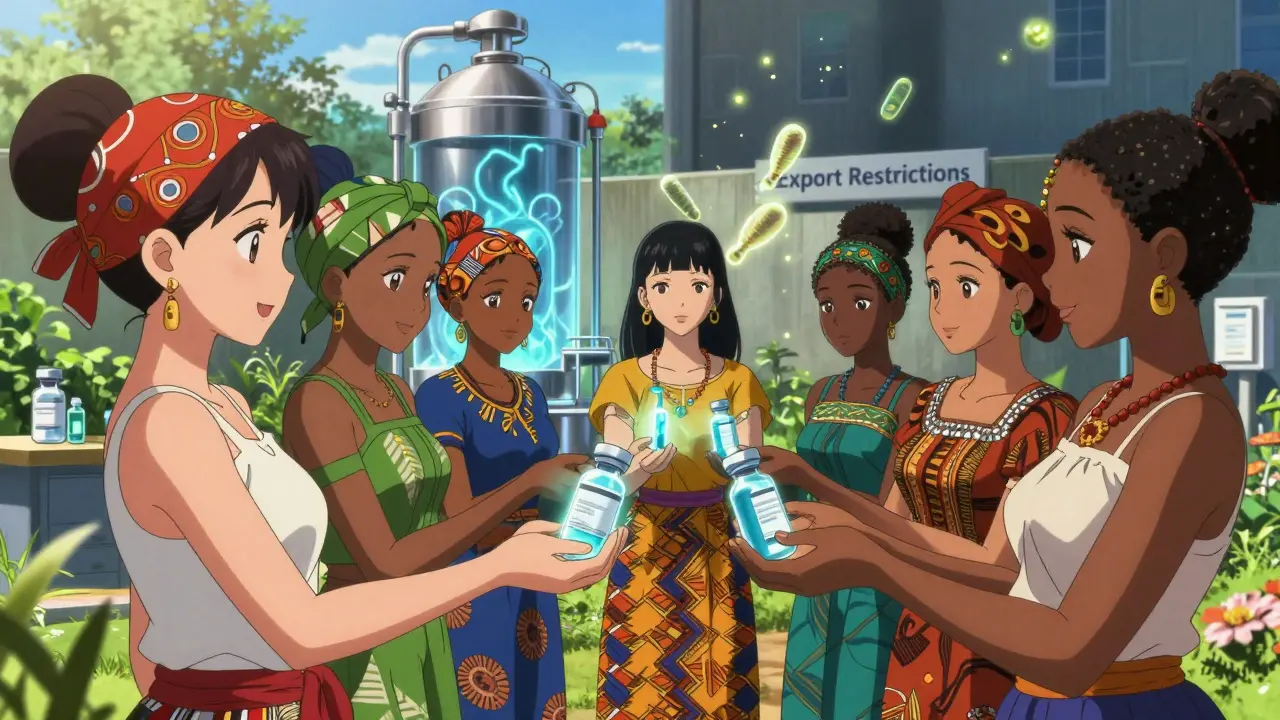
In 2021, the WHO launched a technology transfer hub in South Africa. Partnering with BioNTech, they aimed to train African manufacturers to produce mRNA vaccines locally. It took 18 months just to get the first batch. Why? Equipment delays. Supply chain bottlenecks. Lack of trained technicians. Even with the blueprints, the materials weren’t available. By September 2023, the hub produced its first mRNA doses - but only enough for 100 million doses a year. Global demand? Over 10 billion. That’s 1%.The hub is important. It proves it’s possible. But it’s not scalable. It’s a pilot, not a pipeline. And without massive investment - $4 billion across Africa, according to the African Union - local production won’t reach even 10% of the continent’s needs by 2030. Right now, Africa imports 99% of its vaccines. It produces less than 2%.
Who Controls the Supply Chain? And Why It Matters
Vaccine access isn’t just about making more shots. It’s about who owns the tools to make them. The U.S. FDA’s 2025 pilot program prioritizes generic drug applications made in the U.S. - because 9% of active pharmaceutical ingredient (API) manufacturers are now in America. China has 22%. India has 44%. The U.S. government admits this is a national security risk.But for low-income countries, it’s a life-or-death issue. Médecins Sans Frontières found that in April 2021, 83% of the 1.1 million COVID-19 doses sent to Africa went to just 10 countries. Twenty-three African nations had vaccinated less than 2% of their people. In the Democratic Republic of Congo, health workers received doses with two weeks left before expiration - and no cold chain to deliver them.
There are no substitutes for these systems. No backup suppliers. No quick fixes. When a country like India shuts down exports to save its own population, the entire global system stumbles. And when a country like the U.S. restricts exports of lipid nanoparticles to protect its own supply, it doesn’t just slow down production - it breaks equity.
The Real Barrier Isn’t Technology - It’s Investment
We know how to make vaccines. We’ve done it for decades. The problem isn’t that we lack the science. It’s that we lack the will to invest in the infrastructure that makes them accessible.India can make 1.5 billion doses a year. But it can’t make its own lipid nanoparticles. South Africa can produce mRNA vaccines - but only at 1% of global need. The WHO’s mRNA hub is a triumph of collaboration - but it’s not a manufacturing revolution. It’s a single workshop in a global factory that needs thousands.
Dr. Chris Elias from the Gates Foundation put it plainly: “For vaccine equity in low-income nations, expand manufacturing.” But he also said the biggest barrier is “intensive capital requirements.” That’s the truth. No country can build vaccine capacity alone. No single company can shoulder the cost. And no patent waiver - no matter how well-intentioned - can replace a functioning supply chain.
What’s needed isn’t more speeches. It’s money. Real, sustained, long-term investment in manufacturing hubs across Africa, Southeast Asia, and Latin America. Not just for COVID vaccines - but for routine immunizations: measles, polio, HPV, pneumococcal. Right now, Gavi reports that pneumococcal vaccine prices remain above $10 per dose for low-income countries - even after promises of differential pricing. That’s not affordability. That’s exclusion dressed up as charity.
What Needs to Change
- Invest in regional manufacturing: Africa, Southeast Asia, and Latin America need public-private partnerships to fund vaccine plants - not just one, but ten, twenty. Each plant should be designed to serve 50-100 million people.
- Break raw material monopolies: Governments and NGOs must invest in alternative suppliers for lipid nanoparticles, cell substrates, and bioreactors. Diversify. Don’t rely on five companies.
- Require technology sharing: If a company receives public funding to develop a vaccine (like Moderna did with U.S. taxpayer money), it should be required to share its manufacturing know-how with global hubs.
- Build cold chain infrastructure: No point making vaccines if they can’t be stored or transported. Investment in solar-powered cold storage and refrigerated transport must be tied to vaccine funding.
- End export restrictions: During health crises, critical vaccine inputs must be exempt from trade bans. This isn’t just ethical - it’s practical. When India stopped exports, the world lost half its supply.
The myth of the “generic vaccine” hides a deeper truth: we’ve built a global health system that works only for those who can pay. We’ve outsourced the most critical medical product in history - the vaccine - to a handful of corporations, and then blamed low-income countries for not being able to afford it.
It’s not about making cheaper copies. It’s about making more factories. More skilled workers. More reliable supply chains. More power to the places that need vaccines the most.
The next pandemic won’t wait for patents to expire. It won’t care if a country can’t afford $15 doses. It will come - and it will find us unprepared again. Unless we build the capacity now.
Can generic vaccines be made like generic drugs?
No. Unlike chemical drugs, vaccines are complex biological products made from living cells, viruses, or mRNA. They can’t be proven equivalent through simple lab tests. Each one requires a full new approval process, making true generics impossible under current rules.
Why is India so important for global vaccine supply?
India produces 60% of the world’s vaccines by volume, including 90% of the WHO’s measles vaccine and 70% of its DPT. It’s the largest supplier of affordable vaccines to low-income countries. But it imports 70% of its vaccine raw materials from China and relies on Western technology - making its output vulnerable to global disruptions.
Why haven’t more countries built vaccine factories?
It costs $200-$500 million and takes 5-7 years to build a single facility. The equipment, materials, and expertise are concentrated in a few countries. Most low-income nations lack the capital, infrastructure, and supply chains to start from scratch - even if they have the technical knowledge.
Did the WHO’s mRNA hub in South Africa succeed?
It succeeded in producing its first mRNA vaccine in September 2023 - a historic first for Africa. But its capacity is only 100 million doses per year, less than 1% of global demand. It proves the concept, but it’s not enough to change the system.
Why do low-income countries pay more for vaccines than rich ones?
Manufacturers use a tiered pricing model, but it’s often not enough. Gavi reports pneumococcal vaccine prices stayed above $10 per dose for low-income countries despite promises of discounts. Meanwhile, rich countries bought bulk doses at lower prices during the pandemic. The system still favors those with buying power.
What’s the biggest obstacle to vaccine equity?
It’s not patents or science - it’s investment. Without massive, long-term funding for manufacturing, supply chains, and cold storage in low-income regions, vaccines will always be a privilege, not a right.
TooAfraid ToSay
Wow, so vaccines are like symphonies now? Next you’ll tell me aspirin is just a bad karaoke version of a Mozart concerto. This whole ‘biological complexity’ argument is just corporate FUD dressed up as science. If we can clone sheep, why can’t we clone a vaccine? It’s not about science-it’s about control.