

What Is Bile Acid Diarrhea?
Bile acid diarrhea (BAD), sometimes called bile acid malabsorption (BAM), isn’t just another case of loose stools. It’s a specific condition where too many bile acids leak into the colon and irritate it, causing watery, urgent diarrhea that can last for months or even years. Most people don’t realize their chronic diarrhea might be this-and instead get labeled with IBS-D. But here’s the thing: BAD is treatable. Unlike IBS, which often has no clear fix, BAD responds well to simple, targeted steps once you know what you’re dealing with.
Here’s how it works: your liver makes bile acids to help digest fat. Normally, 95% of those acids are reabsorbed in the last part of your small intestine (the terminal ileum) and recycled. But if that area is damaged-say, from Crohn’s disease, surgery, or just unknown reasons-too much bile ends up in your colon. There, it acts like a laxative, pulling water into the bowel and speeding things up. The result? Frequent, watery bowel movements, often right after eating, sometimes even at night.
How Is It Diagnosed?
Diagnosing BAD isn’t straightforward, which is why so many people go years without the right answer. Doctors often test for IBS first. But if you’ve had chronic diarrhea for over four weeks, especially with no clear trigger, BAD should be on the list. There are three main ways to test for it.
The gold standard is the SeHCAT scan. You swallow a capsule with a tiny bit of radioactive selenium attached to a bile acid. Then, seven days later, they scan your body to see how much was reabsorbed. If less than 15% remains, you have BAD. The problem? This test isn’t available in most U.S. hospitals-it’s common in the UK and Europe, but hard to find stateside.
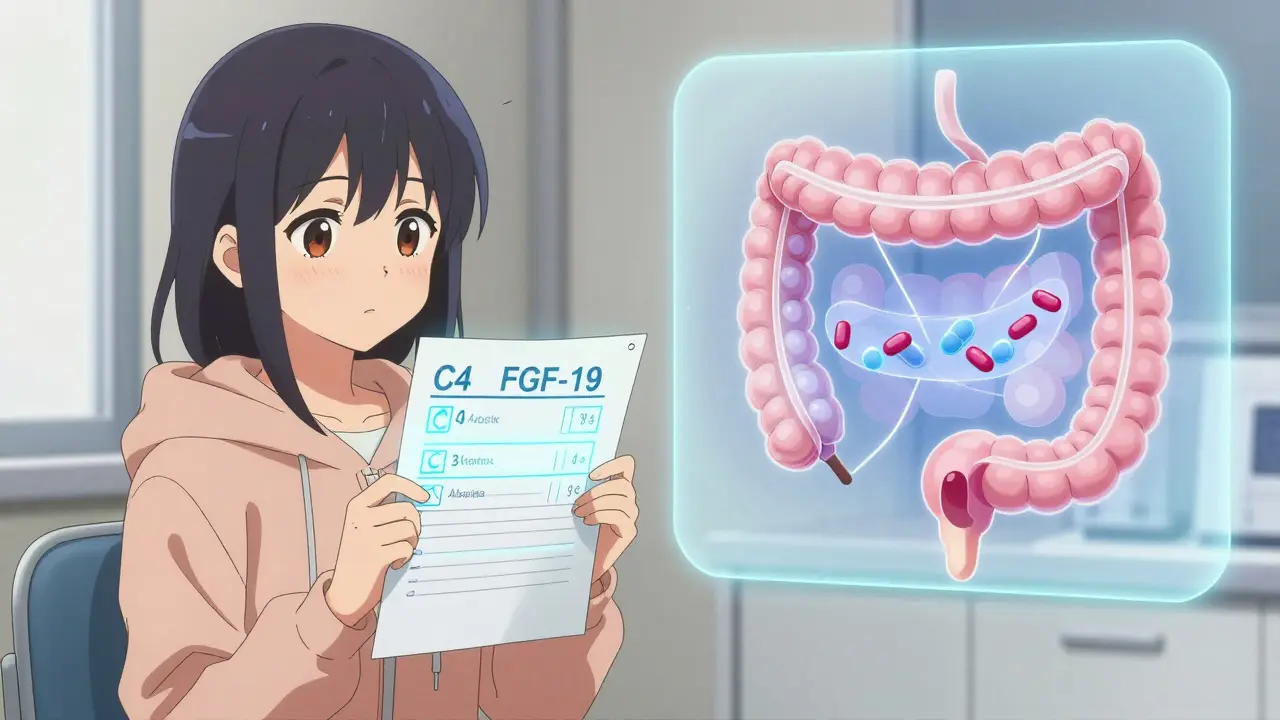
That’s where blood tests come in. Serum C4 measures a chemical your liver makes when producing bile. If your level is above 15.3 ng/mL, there’s a good chance you have BAD. It’s about 77% accurate. Another blood test checks FGF-19, a hormone that tells your liver to slow down bile production. If it’s below 85 pg/mL, your body isn’t regulating bile properly. These two tests are becoming the go-to in places where SeHCAT isn’t available.
There’s also a stool test that measures total bile acids directly, but it’s not widely used because it’s messy, expensive, and requires a 48-hour collection. Most clinics don’t offer it. Still, if your doctor suspects BAD, asking about C4 and FGF-19 is the smartest first move.
How Do Bile Acid Binders Work?
These medications are the cornerstone of treatment. They work like sponges in your gut-binding to bile acids before they reach the colon and flushing them out in your stool. No bile acids in the colon? No diarrhea.
There are three main binders:
- Cholestyramine (Questran): The oldest one. You mix the powder with water or juice. It works well, but many people quit because it tastes awful-like chalky sand-and can cause constipation. Dose: 4 grams once or twice daily.
- Colestipol (Colestid): Comes as granules or tablets. Slightly better taste, but still not great. Side effects are similar to cholestyramine. Dose: 5 grams once or twice daily.
- Colesevelam (Welchol): The newest and most tolerable. It’s a tablet, taken once or twice a day. Only about 5% of users get constipated, compared to 20-30% with the others. It’s also FDA-approved for lowering cholesterol, so it’s often covered by insurance. Dose: 1.875 to 3.75 grams daily.
Studies show about 70% of people with confirmed BAD see major improvement within 2 to 3 days of starting a binder. But here’s the catch: 35% of people stop taking them within six months because of taste or side effects. If you’re struggling, talk to your doctor. Sometimes switching from cholestyramine to colesevelam makes all the difference.
Diet Tips That Actually Help
Medication helps-but what you eat can make or break your progress. You don’t need a fancy diet. Just three simple changes can cut your symptoms in half.
1. Cut Fat Intake
Fat is the main trigger. When you eat fat, your body releases bile. More fat = more bile = more diarrhea. Experts recommend keeping daily fat intake under 40 grams, ideally under 30. That means skipping fried foods, creamy sauces, fatty meats, butter, and full-fat dairy. A study from University Hospitals Coventry & Warwickshire found that people who dropped fat below 30g/day saw a 40% drop in bowel movements. Try swapping bacon for grilled chicken, whole milk for almond milk, and mayo for avocado spread.
2. Add Soluble Fiber
Psyllium husk (like Metamucil) is your friend. It binds bile acids naturally, just like the medication. Take 5 to 10 grams daily-split into two doses, ideally before meals. Clinical trials show this can reduce daily bowel movements by 35%. Start slow: 1 teaspoon a day, then build up. Drink plenty of water or it can cause bloating.
3. Eat Smaller, More Frequent Meals
Three big meals = three big bile releases. Five or six small meals = steadier bile flow. A Cleveland Clinic study found this simple change cut post-meal urgency by 25%. Try snacking on rice cakes with hummus, boiled eggs, or oatmeal instead of waiting for lunch or dinner.
Watch Out for Triggers
- Caffeine: Coffee, tea, energy drinks-these speed up your colon by 15-20%. Switch to decaf or herbal teas.
- Sorbitol and other sugar alcohols: Found in sugar-free gum, diet sodas, and protein bars. They pull water into the gut like a magnet. Read labels.
- Artificial sweeteners: Acesulfame, aspartame, sucralose-some people react badly. Keep a food diary to spot patterns.
What Doesn’t Work
There’s a lot of noise out there. The Specific Carbohydrate Diet (SCD) gets mentioned a lot-eliminating grains, sugars, and lactose. Some people swear by it. But the evidence? A 2019 survey of 120 patients showed only 45% improved. That’s better than nothing, but not as reliable as low-fat + fiber. Avoid extreme diets unless you’re under a dietitian’s care.
Probiotics? Not proven for BAD. While some people report feeling better, no large study shows consistent benefit. The gut microbiome in BAD patients is already different-less Bifidobacteria, more E. coli-but we don’t yet know if probiotics can fix that.
Antidiarrheals like loperamide (Imodium)? They slow things down, but they don’t fix the root cause. You might feel better for a few hours, but bile acids are still irritating your colon. They’re okay for emergencies, but not long-term solutions.
Real-Life Success Stories
On patient forums, the most common success story goes like this: “I was on cholestyramine, hated the taste, and still had 6 bowel movements a day. I switched to colesevelam, cut my fat to under 25g per meal, and started taking 5g psyllium before breakfast and dinner. Within 4 days, I was down to 1-2 soft stools. No urgency. No nighttime trips. I finally slept through the night.”
Another common theme: “I thought I had IBS for 6 years. My GI doc finally ordered a C4 test. It was high. I started colesevelam. Within a week, my life changed.”
Cost is a barrier. In the U.S., colesevelam can run $350-$450 a month without insurance. But many insurers cover it for cholesterol, so ask your doctor to list that as the primary reason. Generic versions exist. And in the UK, it’s often free on the NHS.

What’s Next for BAD Treatment?
The future looks promising. Researchers are developing drugs that mimic FGF-19-the hormone that tells your liver to stop making bile. In early trials, one drug called A3384 improved symptoms in 72% of patients after 12 weeks. That’s better than any binder. These drugs could be available by 2027.
There’s also a new diagnostic tool called BileAcidTest®, which measures C4 levels with 82% accuracy. It’s already approved in Europe and may come to the U.S. soon. And AI apps like BAD-Score are helping people track diet, stress, and symptoms to predict flares before they happen.
Most importantly, experts agree: BAD should be tested for before calling it IBS-D. One study found that 30% of people diagnosed with IBS-D actually had BAD. That’s 1 in 3 people being treated wrong. If you’ve had chronic diarrhea for over a month, ask your doctor: “Could this be bile acid diarrhea?”
When to See a Specialist
If you’ve tried basic changes and still struggle, see a gastroenterologist who specializes in motility or functional GI disorders. Bring your food diary, list of medications, and symptoms. Ask for C4 and FGF-19 blood tests. Don’t accept “it’s just IBS” as an answer. BAD is underdiagnosed, not rare.
Can bile acid diarrhea be cured?
Bile acid diarrhea isn’t usually “cured,” but it’s highly controllable. Most people find long-term relief with bile acid binders and dietary changes. In cases where BAD is caused by surgery or Crohn’s disease, treating the root issue may improve bile absorption. For idiopathic BAD (no clear cause), lifelong management is typical-but with the right approach, symptoms can disappear almost entirely.
Does stress make bile acid diarrhea worse?
Stress doesn’t cause BAD, but it can make symptoms worse. Stress speeds up gut motility and increases sensitivity in the colon. If you’re already dealing with excess bile acids, stress can push you over the edge into urgent, frequent bowel movements. Managing stress with mindfulness, gentle exercise, or therapy can help reduce flares-especially when combined with diet and medication.
Can I take bile acid binders long-term?
Yes. Colesevelam and cholestyramine are safe for long-term use. The biggest concern is nutrient absorption-these binders can reduce absorption of fat-soluble vitamins (A, D, E, K) and some medications. If you’re on long-term therapy, your doctor should check your vitamin levels yearly and may recommend a multivitamin taken at least 4 hours apart from the binder.
Is bile acid diarrhea the same as IBS-D?
No. IBS-D is a diagnosis of exclusion-it’s used when no other cause is found. BAD is a specific biological condition with measurable markers: high bile acids in the colon, low FGF-19, high C4. About 25-30% of people diagnosed with IBS-D actually have BAD. That’s why testing for BAD before labeling someone with IBS-D is critical-it’s a treatable condition, not just a label.
What foods should I avoid with bile acid diarrhea?
Avoid high-fat foods (fried chicken, cheese, butter, cream), caffeine (coffee, energy drinks), artificial sweeteners (especially sorbitol, found in sugar-free gum and diet sodas), and large meals. Alcohol and spicy foods can also irritate the colon. Stick to lean proteins, low-fat dairy or alternatives, cooked vegetables, oats, rice, and bananas. Keep a food diary for 2-4 weeks to spot your personal triggers.
Final Thoughts
If you’ve been living with chronic diarrhea and no one’s figured out why, you’re not alone. But you’re also not stuck. Bile acid diarrhea is more common than you think-and far more treatable than most assume. Start with the basics: cut fat, add psyllium, talk to your doctor about C4 and FGF-19 tests. If binders help, stick with them. If one doesn’t work, try another. And don’t let a bad taste or a stubborn diagnosis stop you. This isn’t just about stopping diarrhea. It’s about getting your life back.
Natasha Rodríguez Lara
I had chronic diarrhea for 5 years and was told it was IBS-D. Then my GI doc ordered a C4 test and it was sky-high. Switched to colesevelam + psyllium and cut fat under 30g/day. Life changed. I can now travel without planning every bathroom stop. Seriously, if you’re struggling, ask for this test. It’s not that hard to get.
Also, the part about sorbitol? YES. I had no idea sugar-free gum was wrecking me. Stopped it cold and noticed a difference in 48 hours.