

Medication Side Effect Comparison Tool
How This Tool Works
Compare side effects of common medications using real risk data and visual representations. This tool follows decision aid best practices by showing absolute risk numbers and helping you clarify what matters most to you.
Side Effect Comparison
What Matters Most To You
Answer these questions to personalize your decision:
Changing medications isn’t just about swapping one pill for another. It’s a decision that can affect how you feel every day - your energy, your sleep, your mood, even your weight. And yet, too many people make this choice without really understanding what they’re getting into. That’s where decision aids come in. These aren’t fancy apps or confusing brochures. They’re practical tools designed to help you and your doctor make a smarter, more personal choice when switching meds.
Why Do People Struggle With Medication Switches?
Think about this: if your doctor says, "Let’s switch from Drug A to Drug B," do you really know why? Most patients don’t. A 2022 study in JAMA Internal Medicine found that between 25% and 50% of people stop taking their new medication within the first year. Not because it doesn’t work - but because they weren’t prepared for the side effects, or they didn’t feel heard.
One woman in Melbourne, on a blood thinner after a stroke, was told to switch from warfarin to a DOAC. She agreed - until she found out the new drug had a 3% chance of internal bleeding each year. That number didn’t mean much to her until she saw an icon array: 100 people, 3 with red dots showing bleeding events. Suddenly, it hit her. "I didn’t realize it was that real," she told her pharmacist. That’s the power of a good decision aid.
What Exactly Is a Decision Aid?
A decision aid is a structured tool - usually digital - that gives you clear, balanced facts about your medication options. It doesn’t push you toward one choice. It shows you the trade-offs.
Here’s what a real, usable decision aid includes:
- Absolute risk numbers - not just "reduces risk by 20%" but "out of 100 people like you, 10 have heart attacks in 5 years on this drug. On the other one, it’s 8."
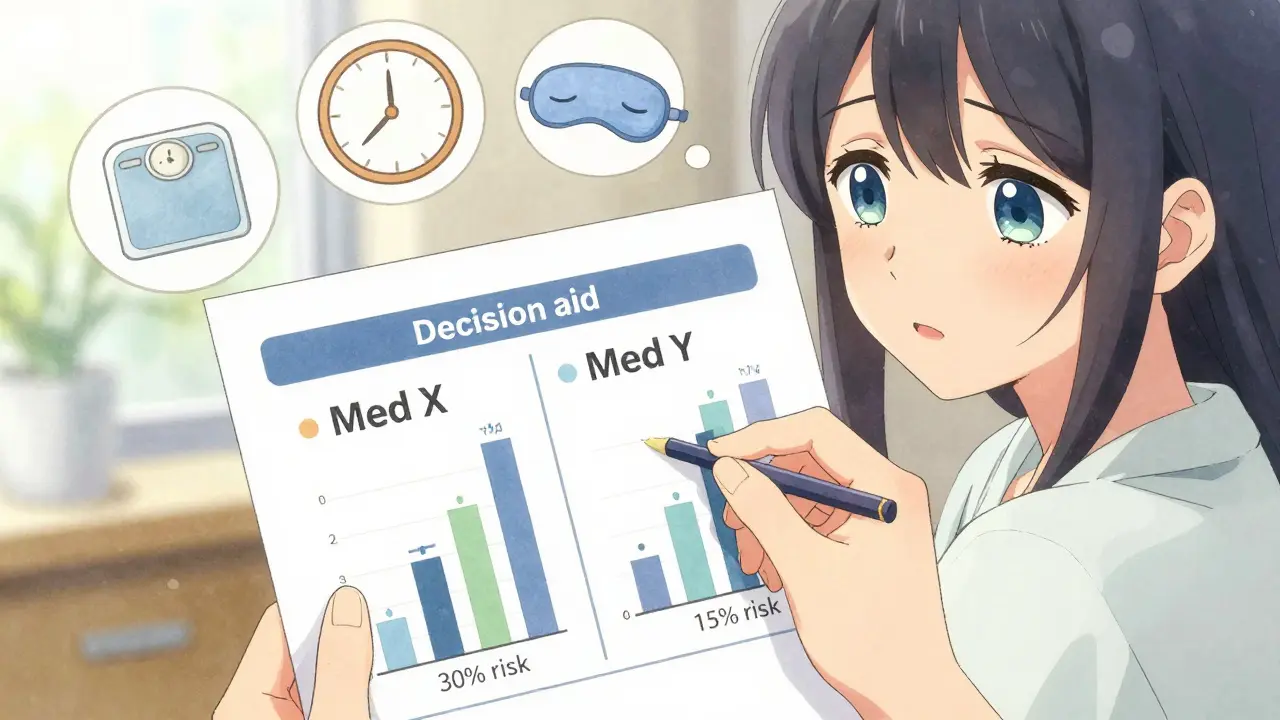
- Side effect comparisons - side-by-side charts showing how likely each drug is to cause weight gain, dizziness, or nausea. For example: "Medication X: 30% chance of weight gain. Medication Y: 15%."
- Visual tools - icon arrays, bar graphs, or even simple drawings that show how many people out of 100 experience each outcome.
- Value clarification - questions like: "How important is taking one pill a day vs. two?" or "Would you avoid a drug that causes dry mouth if it cut your stroke risk in half?"
These tools are built on evidence. The Ottawa Hospital Research Institute and the VA’s MIRECC program have spent years refining them. The VA’s anticoagulant decision aid, updated in 2023, has helped over 100,000 patients make clearer choices.
How Do They Compare to Regular Doctor Advice?
Traditional doctor visits often go like this: "Here’s what we’re switching to. Here’s why. Any questions?"
Decision aids change that. A 2022 review in Patient Education and Counseling looked at 18 different medication-switching interventions. Patients who used decision aids remembered 32% more about their options six months later. They also felt 28% less stressed about the decision.
Why? Because they weren’t just told. They were guided. They had time to think. They saw the numbers. They answered questions about what mattered to them.
Take diabetes meds. There are at least five common options, each with different side effects - weight gain, GI issues, kidney impact, cost. Without a decision aid, many patients just pick the cheapest or the one their friend took. With one? They realize, "I hate taking pills twice a day. I’d rather deal with a little nausea than that." And that’s the right choice for them.
Where Do These Tools Work Best?
Decision aids shine when there’s no single "best" option. They’re not for emergencies. They’re not for when you’re in crisis. They’re for situations where:
- There are two or more equally valid medications
- The side effects differ meaningfully
- Your personal values matter - like cost, dosing schedule, or fear of certain side effects
Experts agree: these tools are most useful for:
- Switching antidepressants (some cause weight gain, others cause sexual side effects)
- Changing blood thinners (warfarin vs. DOACs)
- Choosing between diabetes drugs (GLP-1 agonists, SGLT2 inhibitors, metformin)
- Deciding on osteoporosis meds (bisphosphonates vs. denosumab)
At the VA, 68% of mental health clinics now use decision aids for antidepressant switches. In primary care? Only 29% do. That gap matters. Mental health meds are especially tricky - side effects can feel personal. Losing libido or gaining 10 pounds can make someone quit, even if the drug works.
What Are the Downsides?
They’re not perfect.
Some patients feel overwhelmed. One Mayo Clinic study found 31% of users said, "Too many numbers. I couldn’t keep track." That’s why good decision aids are designed in stages - simple visuals first, then deeper details if you want them.
Another issue? Access. If you don’t have a smartphone, reliable internet, or tech confidence, you might miss out. A 2023 Healthgrades survey found 23% of negative reviews cited difficulty accessing the tool online. That’s why some clinics still print them out or walk patients through them in person.
And then there’s the doctor factor. A 2023 survey of 1,200 U.S. clinicians found 68% said decision aids disrupted their workflow. They don’t have time. They’re not trained. They’re not paid extra for it.
But here’s the thing: when used right, they save time in the long run. A 2022 study showed that after 10 uses, doctors spent 8 minutes less per patient on back-and-forth questions. Why? Because patients came in already informed. They had questions. They were ready to talk.
What Do Real Patients Say?
On Reddit’s r/Pharmacy, a user named u/VetMedSurvivor wrote: "The icon array showing 100 people with 3 bleeding events on DOACs versus 8 on warfarin made it real for me." That post got over 1,200 upvotes.
Another veteran said he declined a switch to a new statin after the decision aid showed a 12% chance of muscle pain - something he’d experienced before. "I’d rather stay on the old one and deal with the liver test than risk that again."
But there are failures too. One case report in the Journal of Patient Experience described a man who thought a decision aid made two drugs "equal" - even though one had decades of safety data and the other was brand new. He switched, had a bad reaction, and blamed the tool. The tool didn’t lie. But the patient didn’t understand that "equal" meant "both valid," not "identical."

How Are They Used in Practice?
The VA’s 4-step process is a good model:
- Identify the decision point. Is this a switch where options are equally valid? If yes, bring in the aid.
- Send it ahead. Give the patient the tool 24-72 hours before the appointment. Let them sit with it.
- Use the visit to talk. Not to explain - to explore. "What stood out to you? What worried you?"
- Document the choice. Write down why they picked what they picked. That helps with future decisions.
Doctors need training too. AHRQ’s 2023 module shows that after 4 hours of practice, 87% of clinicians could confidently guide patients through the aid. That’s doable. It just takes effort.
What’s Next?
The field is moving fast. In early 2024, Intermountain Healthcare launched an AI-powered version that adapts to how you learn. If you’re visual, it shows more icons. If you’re numbers-focused, it highlights stats. If you’re anxious, it slows down the risk explanations.
The FDA is also stepping in. Their 2024 draft guidance says decision aids must be tested on diverse groups - older adults, non-native English speakers, people with low health literacy. That’s a big step toward fairness.
By 2027, experts predict 75% of value-based care systems will use these tools. Why? Because Medicare now rewards clinics that do shared decision-making. It’s not just better care - it’s better business.
What Should You Do?
If you’re being asked to switch meds:
- Ask: "Is there a decision aid I can look at before we decide?"
- Take time. Don’t decide in the 5-minute visit. Ask for a copy to take home.
- Use the value questions. Be honest about what you fear most - weight gain? Dry mouth? Frequent blood tests?
- Bring someone with you. A second set of eyes helps.
If you’re a caregiver or family member: don’t make the choice for them. Help them use the tool. Ask: "What part feels most important to you?"
Decision aids don’t replace your doctor. They help you become a better partner. In a world where medication changes are more common than ever - with new drugs, new side effects, and new risks - knowing how to weigh them isn’t optional. It’s essential.
Anil bhardwaj
Man, I read this and thought about my uncle in Delhi who switched his BP meds and just stopped taking them after a week. No decision aid, no explanation - just "take this pill." He’s fine now, but I swear, if someone had shown him those icon arrays with red dots? He’d’ve stayed on track. Simple visuals, man. Works every time.