

When you pick up a generic pill at the pharmacy, you might assume it’s just a cheaper version of the brand-name drug. But behind that simple swap is a complex, tightly timed review process run by the U.S. Food and Drug Administration (FDA). For manufacturers, getting that green light can mean the difference between staying in business and falling behind. For patients, it means access to affordable medicine. So how long does it really take? The answer isn’t one number-it’s a range, shaped by the drug’s complexity, the quality of the application, and whether it’s flagged for priority review.
What’s the standard timeline for FDA generic approval?
The FDA aims to review a standard Abbreviated New Drug Application (ANDA) in 10 months after accepting it for filing. That’s the official goal under the Generic Drug User Fee Amendments (GDUFA), and it’s the benchmark most companies plan around. But here’s the catch: that clock doesn’t start when you submit your paperwork. First, the FDA has 60 days just to decide if your application is complete enough to even begin reviewing. If key sections are missing-like chemistry data, manufacturing details, or bioequivalence studies-they’ll send it back. No review starts. No clock ticks.
Once accepted, the 10-month review window kicks in. During that time, FDA scientists check everything: is the generic identical in active ingredient, strength, dosage form, and route of administration? Does it dissolve the same way in the body? Is the manufacturing facility clean and reliable? If everything checks out, you get an approval letter. If not, you get a Complete Response Letter (CRL). That’s not a rejection-it’s a to-do list. And fixing those issues can add 3 to 6 months per cycle. In Q2 2025, 42.3% of CRLs came in the first review round, up from 37.8% the year before. That means more applications are getting flagged early, but it also means more delays if the applicant doesn’t fix the problem right the first time.
Why do some approvals take way longer?
Not all generic drugs are created equal. A simple tablet, like doxycycline or ibuprofen, might clear approval in under 12 months. But a complex product-say, an inhaler, a topical cream with a tricky delivery system, or an injectable with special stability requirements-can take years. Why? Because proving bioequivalence isn’t just about matching a pill’s chemical makeup. For complex generics, scientists have to show the drug behaves the same way in the body, which often requires advanced testing and clinical data that doesn’t exist for brand-name drugs anymore.
One Reddit user shared a timeline of 1,087 days-nearly three years-for a nasal spray generic. Another reported 278 days for a standard tablet. That’s a huge gap. The FDA’s own data shows median approval times for complex generics are still 2-3 times longer than for simple ones. That’s why the agency launched its Complex Generic Drug Products initiative in 2023. Dedicated teams now work on these tough cases, and since then, approval times for these products have dropped by 22%. Still, they’re not fast.
What’s a priority review, and does it speed things up?
Yes-but not as dramatically as you might think. Priority review is reserved for generics that address drug shortages, have no competition, or treat serious conditions. The FDA doesn’t publish exact timelines for priority generics, but internal data suggests they’re reviewed in 6-8 months on average, not the full 10. That’s a meaningful difference, especially if you’re trying to get a life-saving medication to patients who can’t wait.
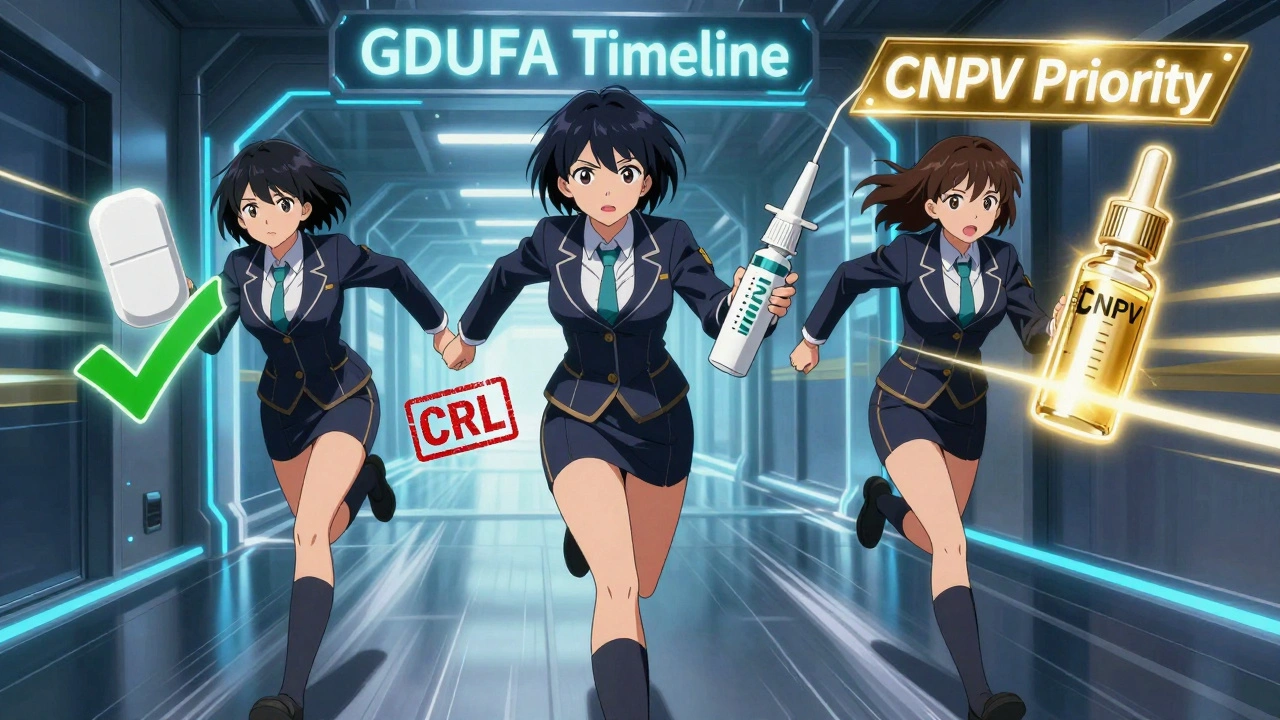
But here’s the real game-changer: the new Commissioner’s National Priority Voucher (CNPV) program. Announced in late 2025, this initiative targets the most urgent cases. Under CNPV, certain applications can jump to the front of the line and get reviewed in just 1 to 2 months. That’s not a typo. It’s a radical shift-from nearly a year to under 60 days. So far, only a handful of applications have qualified, mostly for drugs in critical shortage like epinephrine injections or insulin formulations. But if it scales, this could change how the entire industry operates.
How is the FDA making approvals faster?
It’s not just about more staff or longer hours. The FDA is using technology to cut through red tape. In pilot programs during 2024, artificial intelligence tools helped automate parts of the review process-checking data consistency, flagging missing documents, even predicting potential compliance issues. The result? A 15.8% reduction in review time for standard generics. That’s not flashy, but it’s real.
They’ve also started allowing rolling submissions. Instead of waiting to send a complete ANDA all at once, companies can submit parts as they’re ready-chemistry data now, manufacturing info next month, stability results later. That keeps the review process moving without long pauses. It’s like building a house in phases instead of waiting for every brick to be delivered before laying the foundation.
And the results are showing. Between 2020 and 2024, median approval times for generics dropped by 18.7%. In 2025, the quarterly mean approval time fell to 35.59 days-down from 42.40 days just a year earlier. That’s a 16% improvement in under 12 months. The FDA’s goal under GDUFA III (2023-2027) is to approve 90% of standard applications on time and hit a median of just 20 days for standard generics by 2027. That’s ambitious. But with AI, rolling reviews, and the CNPV program, it’s starting to look possible.
What’s holding things back?
Even with all the progress, bottlenecks remain. The biggest one? Incomplete applications. Too many companies rush to submit, hoping to beat the clock, but skip critical steps. The FDA then spends weeks asking for clarification, which delays everyone. One regulatory manager at Teva said their Type II supplement review cycles dropped 32% since 2023-but only after they invested in better internal quality checks.
Another issue: inspections. Before a generic drug gets approved, the FDA must inspect the manufacturing site. If the facility is overseas, scheduling that inspection can take months. And if the FDA finds violations? The clock stops until the issue is fixed. That’s why companies with strong compliance teams-like Teva, Viatris, and Sandoz-consistently get approvals faster. They don’t just submit applications. They submit clean ones.
Some experts worry the push for speed could hurt safety. Dr. Peter Lurie from the Center for Science in the Public Interest warned in August 2025 that rushing reviews without proper oversight risks letting substandard products into the market. The FDA responds by saying they use a risk-based approach: high-priority drugs get fast-tracked, but every application still goes through the same rigorous science checks. Their data shows no increase in post-approval recalls for generics over the past two years, which suggests the system is holding up.

Who benefits the most from faster approvals?
Patients, first and foremost. Generic drugs now make up 90% of all prescriptions in the U.S. but cost only 23% of what brand-name drugs do. Over the past decade, FDA-approved generics have saved the healthcare system an estimated $1.7 trillion. Every day the approval process shortens, more people get access to affordable meds.
Manufacturers benefit too. The first company to get approval for a generic drug gets 180 days of market exclusivity-no competition. That’s a huge financial incentive. That’s why companies fight to be first. And with the FDA approving more first generics than ever in 2025, the race is on.
Even small businesses are seeing gains. The FDA offers fee waivers for qualifying small companies, and while only 4.7% of ANDA submissions get this break, those that do are seeing approval times drop by 25-30% on average. That’s a lifeline for startups trying to compete with giants.
What should you do if you’re applying for FDA approval?
If you’re a manufacturer or working with one, here’s what actually works:
- Don’t submit until your application is 100% complete. Missing chemistry or manufacturing data is the #1 reason for delays.
- Use pre-submission meetings. The FDA offers free meetings where you can get feedback before you file. Use them. 70% of companies that do report faster approvals.
- Focus on quality, not speed. A clean first submission beats three rounds of revisions every time.
- If your drug is complex or in shortage, apply for priority review or the CNPV program. It’s worth the extra paperwork.
- Work with a regulatory consultant who’s handled ANDAs before. The learning curve is steep, and mistakes are expensive.
The FDA isn’t just a gatekeeper anymore. It’s a partner in getting medicine to people faster. The tools are there. The data shows it’s working. The question now isn’t whether faster approvals are possible-it’s whether the industry is ready to meet the new standard.
How long does it take the FDA to approve a generic drug?
The FDA aims to approve standard generic drug applications within 10 months after accepting the application. However, this timeline can vary widely. Simple generics like tablets may be approved in as little as 8-12 months, while complex products like inhalers or injectables can take 2-3 years. The clock starts only after the FDA accepts the application as complete, which can take up to 60 days. Priority reviews and new programs like the Commissioner’s National Priority Voucher can reduce this to as little as 1-2 months.
What is an ANDA?
ANDA stands for Abbreviated New Drug Application. It’s the form generic drug manufacturers must submit to the FDA to get approval. Unlike brand-name drugs, which require full clinical trials, generics only need to prove they’re bioequivalent to the original drug-same active ingredient, strength, dosage form, and performance in the body. The ANDA process skips redundant safety and efficacy testing, which is why it’s faster and cheaper.
What causes delays in FDA generic approval?
Delays usually come from incomplete or poorly prepared applications, missing manufacturing data, or issues with facility inspections. If the FDA issues a Complete Response Letter (CRL), the applicant must fix the problems and resubmit, which adds 3-6 months per cycle. Overseas inspections can also cause long waits. Complex drug formulations, like nasal sprays or topical gels, require more testing and often face longer reviews.
What’s the difference between standard and priority review?
Standard review targets a 10-month timeline and applies to most generic applications. Priority review is for drugs that treat serious conditions, address shortages, or have no other generic versions available. While the FDA doesn’t publish exact timelines for priority reviews, they typically take 6-8 months. The new Commissioner’s National Priority Voucher program can cut this further to just 1-2 months for the most urgent cases.
Can AI really speed up FDA approval?
Yes. In pilot programs during 2024, AI tools helped automate parts of the review process-checking data consistency, flagging missing documents, and predicting compliance risks. This reduced review times for standard generics by 15.8%. The FDA plans to expand AI use in 2026 and beyond, with the goal of cutting review times even further without compromising safety or quality.
Michael Feldstein
Just saw my local pharmacy switch to a new generic for my blood pressure med-same pill, half the price. Crazy how much the FDA’s backlog has cleared lately. I used to wait 6 months for these, now it’s under 90 days. Feels good knowing the system’s finally working for people like us.