

Imagine taking a medication that was supposed to help your migraines, only to end up with a severe allergic reaction. You tell your doctor, but they're rushed and don't have time to file the paperwork. Or maybe you notice that your insulin pen isn't dispensing the right dose. Do you just hope the manufacturer knows? Or do you take a stand for your own safety and others? Filing a FDA patient reporting complaint is your direct line to the agency that monitors medical safety, bypassing the middleman to ensure a potential danger is on the official record.
While most people assume doctors handle all safety reports, the truth is that patient-led reports are goldmines for the FDA. Why? Because you know your daily routine and your symptoms better than anyone. Clinical trials are great, but they usually only involve a few thousand people. In the real world, a side effect might only hit 1 in 10,000 people-that's where your report becomes a critical "safety signal" that can trigger a national warning or a product recall.
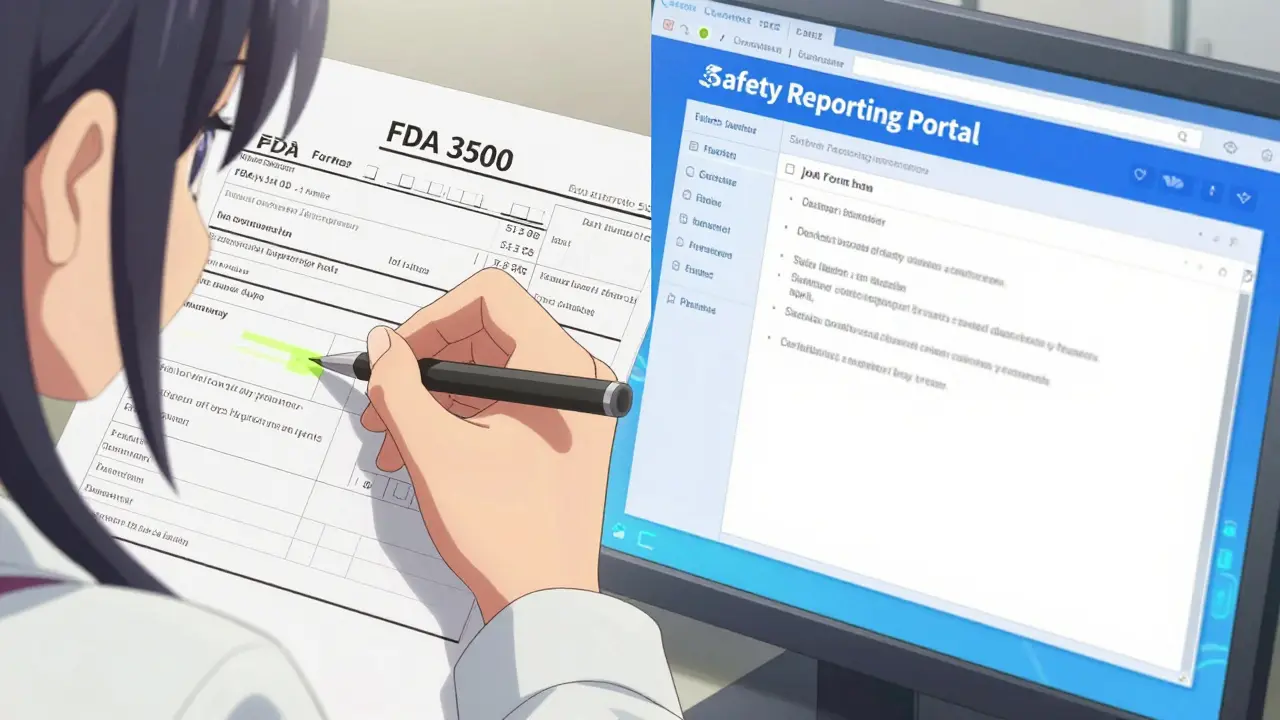
| Method | Best For... | Estimated Time | Key Pro/Con |
|---|---|---|---|
| Safety Reporting Portal (SRP) | Tech-savvy users wanting fast submission | 15-20 mins | Fast but can be glitchy |
| FDA Form 3500 (Paper) | Detailed records or portal crashes | 25-30 mins | Reliable but slower |
| Phone (1-800-FDA-1088) | People who hate forms | Varies | Direct help; limited hours |
What Exactly Should You Report?
You don't need to be a medical expert to file a report. The FDA is looking for a few specific types of issues. First, there are adverse reactions-these are any unexpected or harmful side effects. Then there are product quality problems, like a pill that's crumbling or a medical device that keeps malfunctioning. You should also report "therapeutic failures," which is a fancy way of saying the drug simply didn't work when it was supposed to.
This applies to a wide range of products. It's not just prescription drugs; it includes biologics, medical devices (like pacemakers or glucose monitors), dietary supplements, infant formula, and even cosmetics. If it's regulated by the FDA and it caused a problem, it's reportable. For example, in early 2024, 287 consumer reports about improper insulin pen storage led to a formal safety communication. That's the real-world impact of a single person deciding to speak up.
Step-by-Step: How to File Your Complaint
Getting your report in isn't as scary as it sounds, but you'll need to gather some intel first. The more specific you are, the more useful your report is to the Center for Drug Evaluation and Research (CDER) or the Center for Biologics Evaluation and Research (CBER).
- Gather Your Evidence: Find the product packaging. You'll need the product name, the lot number (this is the specific batch ID), and the expiration date. Note that lot numbers are missing from about 38% of consumer packaging, but provide them if you can.
- Document the Event: Write down exactly what happened. When did the symptoms start? How long did they last? Did you take any other over-the-counter meds at the same time?
- Choose Your Channel:
- Online: Use the Safety Reporting Portal (SRP). It's the fastest way, though some users have reported crashes. If you're using the new 2025 version, look for the "symptom description wizard" to help you describe your reaction more accurately.
- Paper: Download FDA Form 3500 (or Form 3500B if you prefer Spanish). Fill it out and mail it in.
- Phone: Call 1-800-FDA-1088 between 8:00 AM and 8:00 PM EST, Monday through Friday.
- Submit and Confirm: After submitting, keep an eye on your inbox. Per FDA procedure, you should get a confirmation email within five business days.
Patient Reports vs. Doctor Reports: Why Yours Matter
You might wonder, "Why should I do this if my doctor can just do it?" Here is the secret: patients often provide *better* data for certain things. A study in Drug Safety found that patient reports contained 37% more detail about when symptoms actually started compared to doctor reports. Doctors see you for 15 minutes; you live with the symptoms 24/7.
Patient reports are also 2.3 times more likely to identify "use errors." This happens when a product is designed in a way that's confusing, leading people to use it wrong. Manufacturers might see a failure and assume the user was careless, but your report can show the FDA that the design itself is the problem. However, the downside is that patient reports often lack clinical verification. Only about 62% of consumer reports have the medical documentation needed for a full evaluation, whereas 89% of physician reports do. This is why it's helpful to attach any lab results or clinic notes you have.
The "Black Hole" Effect: What Happens After You Hit Submit?
Many people feel like their report goes into a void. In reality, your data feeds into the FDA Adverse Event Reporting System (FAERS), a massive database with over 25 million records. The FDA doesn't usually send a personal letter back saying "we fixed it," but they use AI-assisted triage to scan these reports for patterns.
If 50 people in different states all report the same weird rash from the same batch of a cream, that's a "signal." This can lead to a label change, a restricted distribution, or a full recall. To speed this up, the FDA's 2025-2027 Strategic Plan aims to get processing times down to just five business days by the end of 2026. They are also working on a unified reporting system to stop the confusion of having six different portals for different products.

Common Pitfalls and Pro Tips
To make sure your report doesn't get tossed aside for being incomplete, keep these tips in mind:
- Avoid Vague Terms: Instead of saying "I felt weird," say "I experienced dizziness and tingling in my left arm starting 20 minutes after the first dose."
- Don't Skip the Lot Number: Even if it's hard to find, that number is the key to finding out if a specific factory had a quality failure.
- Confidentiality is Key: Under 21 CFR 10.75, your identity is protected. The FDA doesn't just hand your name and address to the company that made the drug without your consent.
- Report Even If You're Not Sure: You don't have to *prove* the drug caused the reaction. If you suspect a link, report it. Let the FDA's scientists do the proving.
Do I have to wait for my doctor's permission to report to the FDA?
No. Patient reporting is entirely voluntary and direct. You do not need a physician's sign-off or referral to use the Safety Reporting Portal or mail in a Form 3500.
Will the drug company contact me if I file a complaint?
Generally, no. The FDA protects reporter confidentiality under federal regulations. While the FDA may share the details of the adverse event with the manufacturer to help them investigate, your personal identity is not disclosed without your permission.
What if the Safety Reporting Portal crashes while I'm filling it out?
This is a known issue. If the portal fails, the best backup is to download the PDF version of FDA Form 3500, fill it out manually, and mail it to the address provided on the form. You can also call the 1-800-FDA-1088 help line.
How long does the FDA take to process a patient report?
Initial processing has been reduced to about 9 business days thanks to new AI triage systems. You should receive a confirmation email within 5 business days of submission.
Can I report a supplement or a cosmetic, or is this only for prescription drugs?
You can report any FDA-regulated product, including dietary supplements, cosmetics, infant formula, and medical devices. Any product that causes an unexpected health issue should be reported.
Next Steps for Different Situations
If you are in a medical emergency: Do not spend time filling out a form. Call 911 or go to the ER. File the FDA report once you are stable.
If you are a caregiver reporting for someone else: You can file on their behalf. Just be clear in the demographics section about your relationship to the patient and provide as much detail as possible about the observed symptoms.
If you're worried about the technicality of your language: Use the Patient Reporting Toolkit's symptom wizard. It helps translate "I felt like my heart was skipping" into terms that the FDA's database can categorize more effectively.
Nikolai Mortenson
Hello, my name is Nikolai Mortenson, and I am a dedicated expert in the field of pharmaceuticals. I have spent years studying and researching various medications and their effects on the human body. My passion for understanding diseases and their treatments has led me to become a prolific writer on these topics. I aim to educate and inform people about the importance of proper medication usage, as well as the latest advancements in medical research. I often discuss dietary supplements and their role in health maintenance. Through my work, I hope to contribute to a healthier and more informed society. My wife Abigail and our two children, Felix and Mabel, are my biggest supporters. In my free time, I enjoy gardening, hiking and, of course, writing. Our Golden Retriever, Oscar, usually keeps me company during these activities. I reside in the beautiful city of Melbourne, Australia.
view all postsWrite a comment