

What Huntington’s Disease Really Means
When someone is diagnosed with Huntington’s disease, it’s not just a label-it’s a life-altering shift. This isn’t a slow decline you can ignore. It’s a genetic time bomb ticking inside your cells, slowly breaking down the parts of your brain that control movement, thought, and emotion. The disease doesn’t pick favorites. If your parent had it, you have a 50% chance of inheriting it. No exceptions. No second chances. And once symptoms start, there’s no turning back.
The first clue for many isn’t memory loss or confusion. It’s something subtle: fingers tapping uncontrollably, a foot that won’t stop twitching, or an odd facial grimace that won’t go away. These aren’t nervous habits. They’re chorea-the signature movement disorder of Huntington’s. It looks random, like dancing without music. But it’s not. It’s your brain losing its ability to filter signals. The neurons in your striatum, the part that helps coordinate smooth motion, are dying. And once they’re gone, they don’t come back.
The Genetic Clock: How Your DNA Decides Your Future
Every person with Huntington’s disease carries the same genetic flaw: too many CAG repeats in the HTT gene on chromosome 4. Normal people have 10 to 26 repeats. People with the disease have 40 or more. Between 27 and 35, you won’t develop symptoms-but you might pass on a mutated version to your kids. That’s why some families see the disease jump generations, suddenly appearing in a grandchild even if the parent never showed signs.
Here’s the cruel twist: if your dad had Huntington’s, your risk of getting it earlier-and more severely-is higher. About 85% of juvenile cases come from the father’s side. Why? Because sperm cells tend to add more CAG repeats when passing the gene along. A father’s 42 repeats might become 52 in his child, pushing the onset from age 45 to age 15. That’s genetic anticipation in action. It’s not magic. It’s biology. And it’s devastating.
Testing for the gene is possible. But 30% of people at risk never get tested. Why? Fear. Guilt. The weight of knowing. One woman in the HDSA forum wrote: “I didn’t want to be the one who told my kids they might be next.” That silence doesn’t protect anyone. It just delays the hard conversations.
Chorea: More Than Just Uncontrolled Movements
Chorea isn’t just annoying. It’s exhausting. Imagine trying to hold a cup of coffee while your arm keeps jerking sideways. Or walking down the street while your legs shift direction without your permission. You can’t sit still. You can’t sleep well. You can’t eat without spilling. And it gets worse under stress.
Doctors measure chorea using the Unified Huntington’s Disease Rating Scale (UHDRS). A score of 1 means slight, occasional movements. A score of 4 means constant, violent jerking that makes holding your head up difficult. In early stages, chorea is mostly in hands and feet. By mid-stage, it spreads to the face, neck, and torso. Later, it fades-not because it’s getting better, but because muscles are too weak to move at all. That’s when dystonia and rigidity take over.
There are two drugs approved to treat chorea: tetrabenazine and deutetrabenazine (Austedo). Both work by lowering dopamine levels in the brain. They reduce chorea by about 25-30%. But here’s the catch: 22% of people on tetrabenazine develop depression. Some even have suicidal thoughts. That’s why doctors don’t rush to prescribe them. You have to weigh movement control against emotional survival. For some, the chorea is worse than the side effects. For others, the drugs feel like trading one nightmare for another.

Care Planning: The Only Thing That Actually Helps
There’s no cure. No magic pill. No miracle drug on the horizon that will save you tomorrow. But there is something that makes a real difference: care planning. Not vague wishes. Not a will signed in haste. A detailed, living plan built with doctors, therapists, family, and lawyers-before you lose the ability to speak for yourself.
At diagnosis, you should already be talking about:
- Who will make medical decisions if you can’t?
- What kind of care do you want at each stage?
- Where do you want to live as things get harder?
- How will you pay for it?
Studies show people who do this live 2.3 years longer. Why? Because they avoid emergency hospital trips for pneumonia. They avoid suicide. They avoid the chaos of last-minute decisions made in panic.
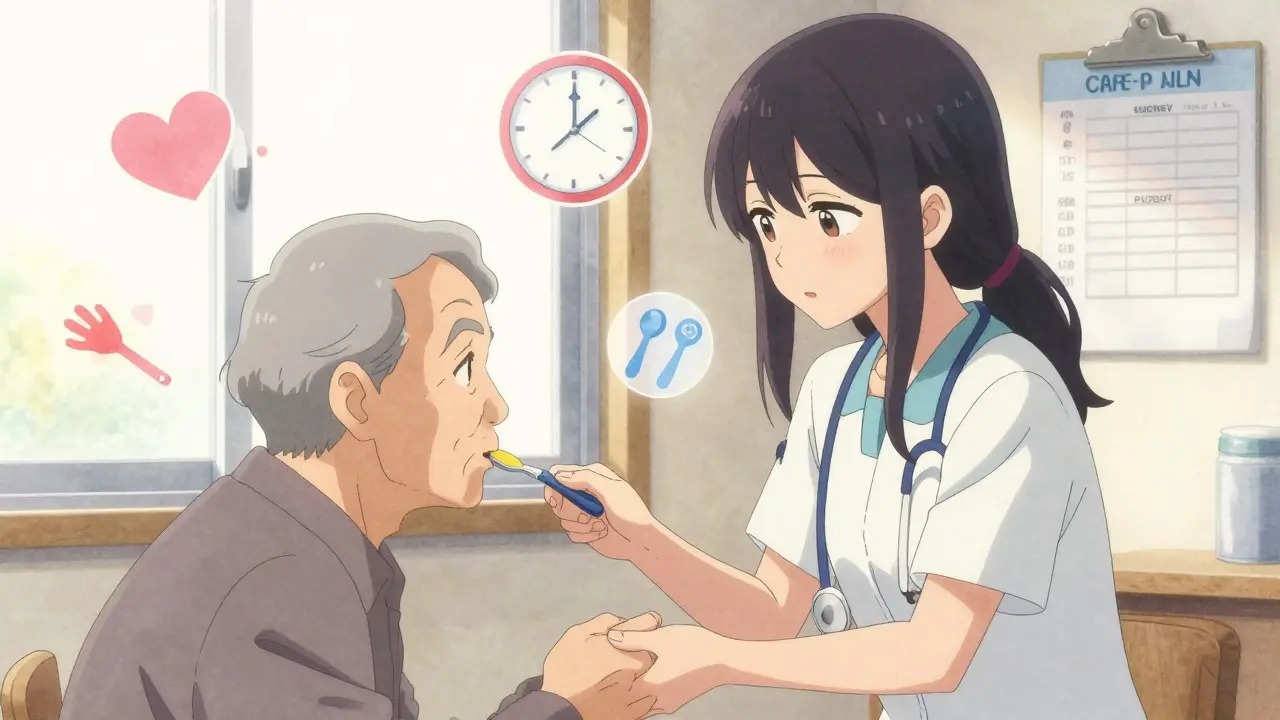
By year five, most people need help with dressing, bathing, and eating. Occupational therapists teach you how to use adaptive tools-weighted utensils, non-slip mats, voice-activated devices. Speech therapists help with slurred speech and swallowing risks. By year ten, nearly half need speech therapy. By year fifteen, most need full-time care. And by year twenty, 89% live in residential facilities.
Costs hit $125,000 a year. Insurance rarely covers everything. Many families spend $5,000 out-of-pocket annually just for physical therapy, home modifications, or specialized equipment. Aquatic therapy helps balance better than land-based exercises-but it’s not always available. And it’s expensive.
The Hidden Crisis: Caregivers Are Breaking
Behind every person with Huntington’s is someone else holding them up. A spouse. A child. A sibling. They’re not trained nurses. They’re not paid. They’re just there.
One caregiver in the UK told me: “I used to be a teacher. Now I’m a feeding assistant, a toilet helper, a safety monitor, a therapist, and a grief counselor-all before breakfast.”
63% of caregivers spend 15 or more hours a week managing appointments, insurance, medications, and emergencies. Many quit their jobs. Many lose friendships. Many get depression themselves. And they rarely ask for help because they feel guilty.
Specialized Huntington’s clinics-like the 53 certified by HDSA in the U.S.-are the only places that coordinate all this. But only 38% of U.S. neurologists follow the official guidelines. Rural patients wait over two years to see a specialist. In Europe, only 28% have access to full care teams. That’s not just a gap. It’s a crisis.
What’s Next? Hope, But Not Hype
There are clinical trials. Lots of them. Wave Life Sciences’ drug reduced mutant huntingtin protein by 38% in early tests. Roche’s tominersen was paused, then restarted with lower doses. Valbenazine (Ingrezza) got FDA approval in 2023 as a second chorea option.
But none of these are cures. None of them reverse damage. Even if a gene therapy works tomorrow, it won’t help the 40,000 Americans already living with symptoms. That’s why experts say: care planning isn’t optional. It’s essential-even if a cure comes next year.
Dr. Rachel Andre at Johns Hopkins put it plainly: “Even with successful gene therapies, comprehensive care planning will remain critical for the 40,000+ Americans currently living with HD symptoms.”
What You Can Do Right Now
- If you have a family history: Get genetic counseling before testing. Don’t go alone.
- If you’ve been diagnosed: Schedule a care planning meeting within six months. Bring a family member.
- If you’re caring for someone: Join a support group. You’re not alone. HDSA and EHDN have online forums.
- If you’re a clinician: Learn the UHDRS. Know the guidelines. Refer early.
There’s no cure yet. But there’s still control. You can choose how you face this. You can choose who’s by your side. You can choose to plan-not out of fear, but out of love.
Can you get Huntington’s disease if neither of your parents had it?
No. Huntington’s is an autosomal dominant disorder, meaning you must inherit the mutated gene from at least one parent. If neither parent has the gene, you cannot develop the disease. Rare cases where a person has no known family history are usually due to misdiagnosis, adoption, or a new mutation-but those are extremely uncommon, accounting for less than 1% of cases.
Is chorea the only symptom of Huntington’s disease?
No. Chorea is the most visible symptom, but HD affects three areas: movement, thinking, and mood. Cognitive decline includes trouble planning, focusing, and making decisions. Psychiatric symptoms include depression (up to 40% of patients), anxiety, irritability, and obsessive behaviors. Suicide rates are 7-10 times higher than the general population. All three areas must be managed together.
How long do people live after being diagnosed with Huntington’s disease?
On average, people live 15 to 20 years after symptoms begin. Those with juvenile onset (before age 20) often live 10 to 15 years after diagnosis. Death usually results from complications like pneumonia, heart failure, or injuries from falls. Care planning reduces these risks significantly-especially when swallowing problems and depression are managed early.
Can lifestyle changes slow down Huntington’s disease?
No drug or diet can stop the genetic damage. But lifestyle can improve quality of life. Regular physical activity-especially aquatic therapy-helps maintain mobility and balance. A high-calorie diet prevents weight loss, which is common as swallowing becomes harder. Sleep hygiene reduces fatigue. Mental stimulation helps preserve cognitive function longer. These won’t change the course of the disease, but they help you live better while you can.
Is genetic testing for Huntington’s disease worth it?
It’s deeply personal. For some, knowing removes uncertainty and allows for life planning-career choices, family decisions, financial steps. For others, the emotional burden is too heavy. 95% of people who get tested receive pre-test counseling, and nearly all say they’re glad they did-even if the result was positive. The key is never testing alone. Always do it with a genetic counselor and psychological support.
Michael Burgess
I've seen this up close with my uncle. The chorea starts so quiet-just a finger twitch at dinner-then suddenly, he can't hold a spoon. No one talks about how exhausting it is to watch someone you love lose control of their own body. The drugs? They help a little, but then he got so depressed he stopped talking. We chose quality over quantity. He still laughs at old sitcoms. That’s our win.