
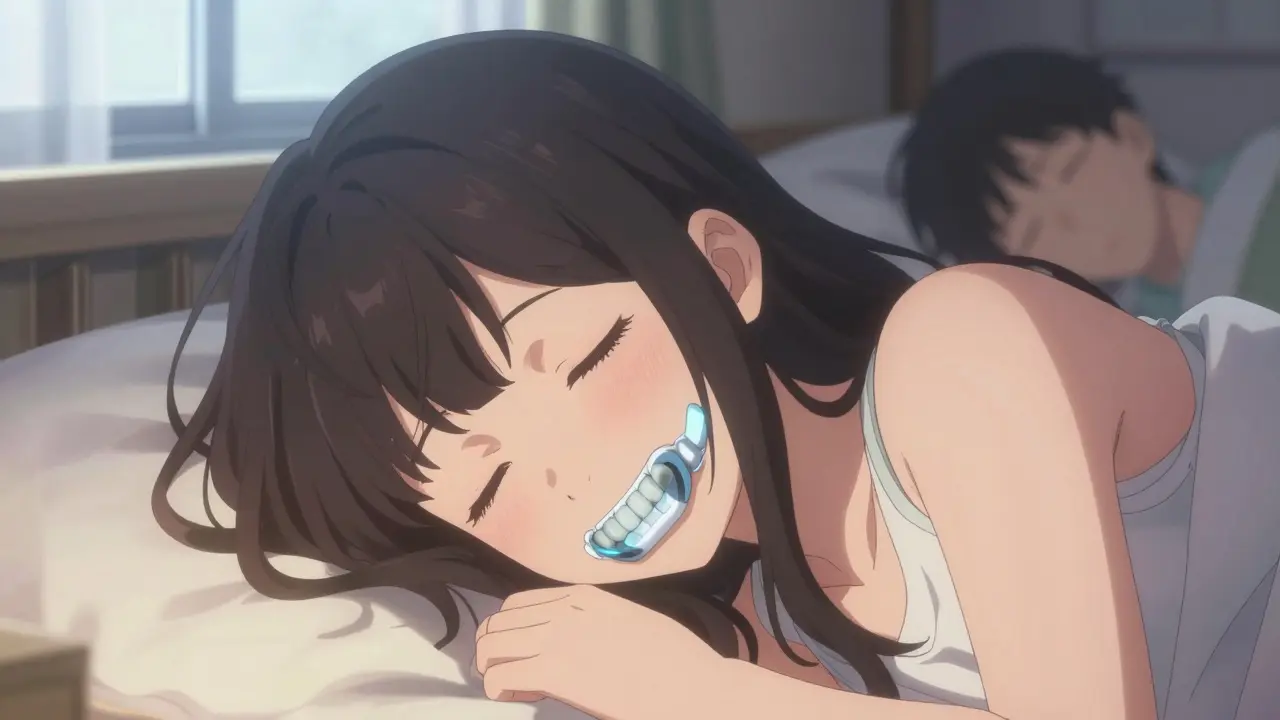
Snoring isn’t just annoying-it can be a sign of something deeper. If you or your partner wake up tired, feel exhausted during the day, or hear loud, irregular snoring every night, you might be dealing with obstructive sleep apnea or just chronic primary snoring. Either way, there’s a solution that doesn’t involve a mask, tubes, or constant noise: oral appliance therapy using a mandibular advancement device (MAD). Unlike CPAP machines, which many people find uncomfortable or claustrophobic, MADs are small, quiet, and fit right in your mouth like a sports mouthguard. And for millions of people, they work.
How a Mandibular Advancement Device Stops Snoring
Snoring happens when the muscles in your throat relax too much during sleep, causing your tongue and soft palate to collapse backward and partially block your airway. As air tries to squeeze through, it vibrates those tissues-and that’s the sound you hear.
A mandibular advancement device works by gently holding your lower jaw forward. This simple movement pulls your tongue and soft tissues away from the back of your throat, keeping your airway open. Think of it like pulling a door slightly ajar so it doesn’t slam shut. The device doesn’t force your jaw into an unnatural position; it just gives it a little nudge-usually between 3 and 10 millimeters-based on your anatomy.
Custom-made MADs are crafted from semi-rigid acrylic with titanium connectors. They’re molded from dental impressions taken by a sleep dentist, ensuring a precise fit. Over-the-counter versions, like Zyppah or Good Morning Snore Solution, use thermoplastic material you soften in hot water and bite into. But here’s the catch: custom devices are far more effective. A 2015 meta-analysis found they reduced snoring by 72.3%, while over-the-counter ones only managed 48.6%. That’s not a small difference-it’s the difference between quiet nights and still-awake partners.
Who Benefits Most from Mandibular Advancement Therapy
Not everyone who snores is a good candidate. The American Academy of Sleep Medicine recommends MADs for people with primary snoring or mild-to-moderate obstructive sleep apnea-especially if they can’t tolerate CPAP.
Good candidates typically have:
- At least 6-8 natural teeth in both upper and lower jaws
- No severe gum disease or loose teeth
- Healthy temporomandibular joints (TMJ)
- A body mass index (BMI) under 35
- Snoring that worsens when lying on the back
People with severe sleep apnea (AHI over 30) or those with complete airway collapse (Mallampati class IV) usually don’t benefit. In fact, studies show MADs fail in nearly 40% of these cases. If you’ve been told you need CPAP but hate it, MADs are a solid second option. If you’re just a loud snorer with no apnea, they’re often the best non-surgical choice.
Effectiveness Compared to Other Treatments
How does MAD stack up against other solutions?
CPAP is still the gold standard for eliminating snoring and apnea events-it works for 85-95% of users. But here’s the problem: only about half of people stick with it after a year. The mask leaks, it’s noisy, it dries out your nose, and some people feel trapped wearing it. MADs, on the other hand, have a 76.4% long-term adherence rate. That’s why, even though they’re less effective at stopping apnea completely, they’re becoming the go-to for many patients.
Compared to other alternatives:
- Nasal dilators (like strips or cones) reduce snoring by only 20-30%
- Positional therapy (sleeping on your side) helps 35-45% of people
- Surgery (like UPPP) can work but carries risks, recovery time, and no guarantee of success
MADs hit a sweet spot: they’re non-invasive, portable, quiet, and effective enough for most mild-to-moderate cases. In a 2014 study, thermoplastic MADs cut snoring frequency by 63.2% compared to placebo devices. Real-world users report snoring dropping from 65 decibels (loud enough to wake someone) to 38 decibels (a quiet conversation).
The Downsides: Side Effects and Long-Term Risks
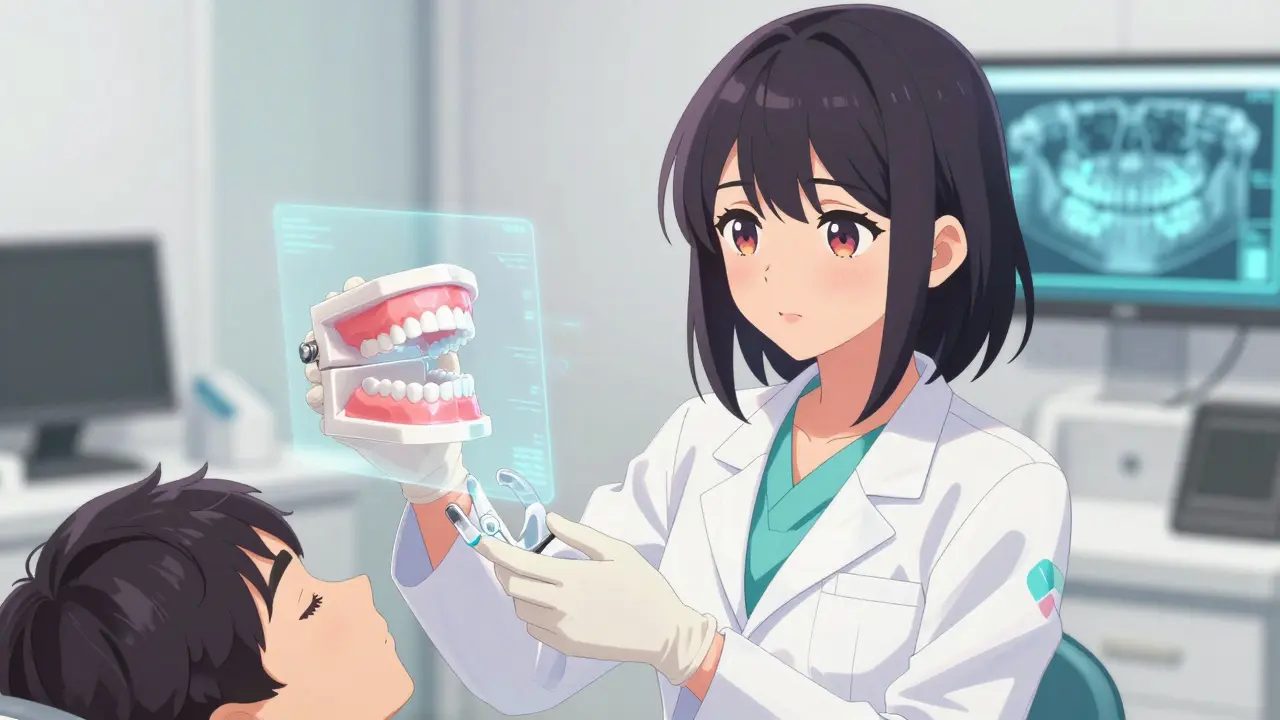
Nothing’s perfect. About 25% of long-term MAD users develop dental changes. That means your bite might shift slightly-your front teeth might not line up the same way, or you might feel your jaw is a little off. In 14.7% of cases, people need orthodontic work after five or more years of use.
Other common side effects include:
- Morning jaw pain (reported by 68% of new users)
- Excessive saliva (43%)
- Tooth discomfort (29%)
- Temporomandibular joint (TMJ) soreness
Most of these fade after 2-4 weeks as your jaw adjusts. But if pain lasts longer than a month, you need to see your dentist. Many specialists recommend wearing the device for an hour or two during the day at first to get used to it. Warm water soaks can also help soften the material if adjustments are needed.
And here’s the hard truth: if you stop wearing it, snoring comes back within 48 hours. It’s not a cure-it’s a management tool. You have to wear it every night.
How to Get Started: The Step-by-Step Process
You can’t just buy a MAD off Amazon and expect it to work. Proper use requires a medical and dental pathway.
- Get tested-Start with a home sleep test or polysomnography to rule out severe sleep apnea. If your AHI is over 30, CPAP is still your best bet.
- See a sleep dentist-Not all dentists do this. Look for one certified by the American Academy of Dental Sleep Medicine. They’ll examine your teeth, jaw, and airway.
- Get impressions-In-office digital scans are 23% more accurate than at-home kits. Avoid DIY molds unless you’re on a tight budget and understand the trade-offs.
- Wait for your device-Custom MADs take 2-4 weeks to make. You’ll get a trial version first to check fit.
- Titrate slowly-Your dentist will have you increase jaw advancement by 1mm every 3-5 days over 4-6 weeks. Too much too fast causes pain. Too little won’t help.
- Follow up-You’ll need 2-3 checkups in the first 3 months. After that, dental visits every 6 months are critical to monitor for tooth movement or jaw issues.
Costs range from $1,800 to $2,500 for custom devices like the SomnoDent MAS or TAP 3. Insurance rarely covers it-only 38% of U.S. plans do. Many people pay out of pocket.
What’s New in Oral Appliance Therapy
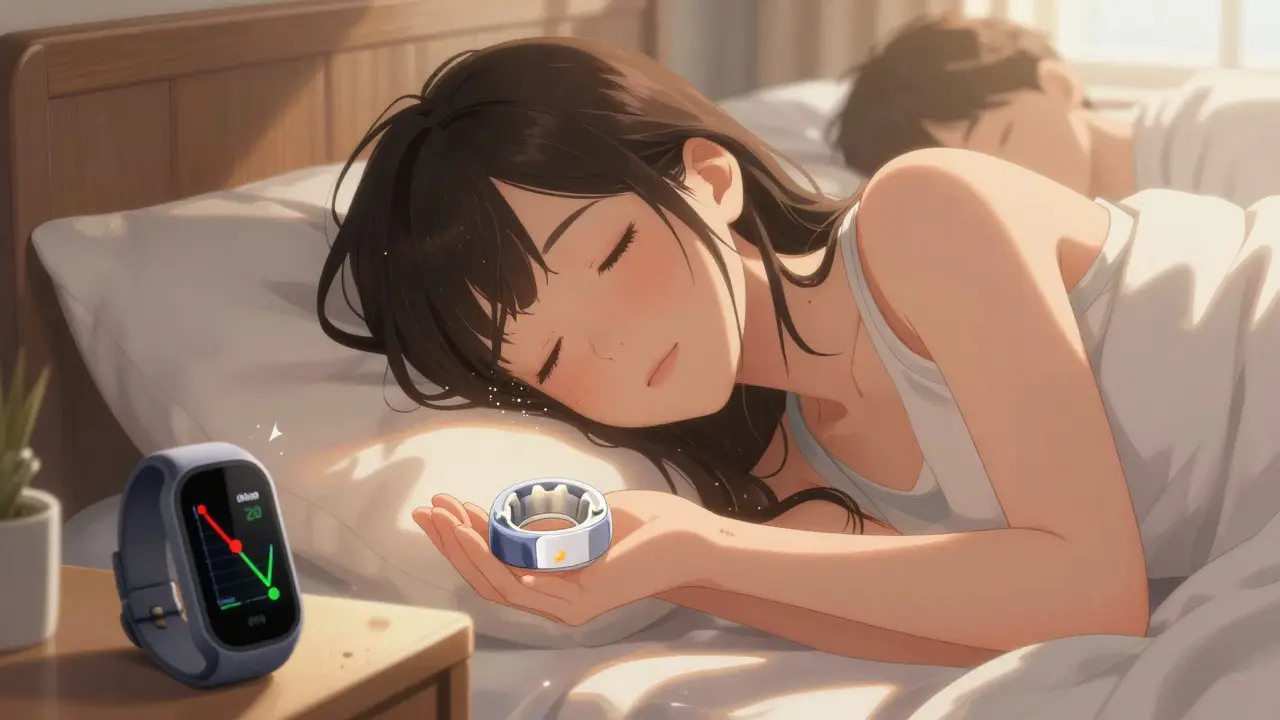
The field is evolving fast. In 2023, the FDA cleared the SomnoDent EVO 3, which has built-in sensors that track your jaw position and snoring levels. It syncs with a smartphone app so you can see real-time data on how well the device is working.
Next up: AI-driven titration. Sleep Solutions Inc. is launching a device in 2024 that uses machine learning to adjust jaw position automatically based on your breathing patterns. And researchers are exploring genetic markers that might predict who responds best to MADs-so someday, you might get a personalized device based on your DNA.
Market growth is strong too. The global oral appliance market hit $1.28 billion in 2022 and is expected to nearly double by 2030. In the U.S., 14.6% of snorers now use MADs, up from just 5.2% in 2015. More people are realizing that you don’t need to live with loud nights.
Real People, Real Results
On Reddit, one user named u/SnoringHusband posted: “My wife measured my snoring before and after. It went from 65dB to 38dB. She finally sleeps through the night. Worth every penny of the $2,200.”
But others aren’t as happy. On Sleep Apnea Forums, 68% of users reported jaw pain in the first few weeks. One wrote: “I hated it at first. Felt like my teeth were being pushed apart. But after a month, it became normal. Now I can’t sleep without it.”
The data backs this up. Long-term users (over two years) report 81.6% satisfaction with snoring reduction-but 63.2% worry about dental changes. That’s the trade-off: better sleep, but potential dental costs down the line.
Final Thoughts: Is It Worth It?
If you’re tired of being the person who wakes everyone up-or the partner who’s always half-asleep-MADs are one of the most practical solutions available. They’re not magic. They require commitment, follow-up care, and some upfront cost. But for the right person, they’re life-changing.
They won’t work for everyone. If you have severe sleep apnea, missing teeth, or TMJ problems, talk to your doctor first. But if you’re a healthy snorer looking for a quiet, portable, non-invasive fix, oral appliance therapy is worth serious consideration.
And if you’ve tried everything else? It might be the answer you’ve been waiting for.
Shane McGriff
Been using a MAD for three years now. Jaw pain vanished after the first month, and my wife hasn’t complained about snoring since. It’s not glamorous, but it’s the only thing that kept her from sleeping in the guest room. Worth every penny.