
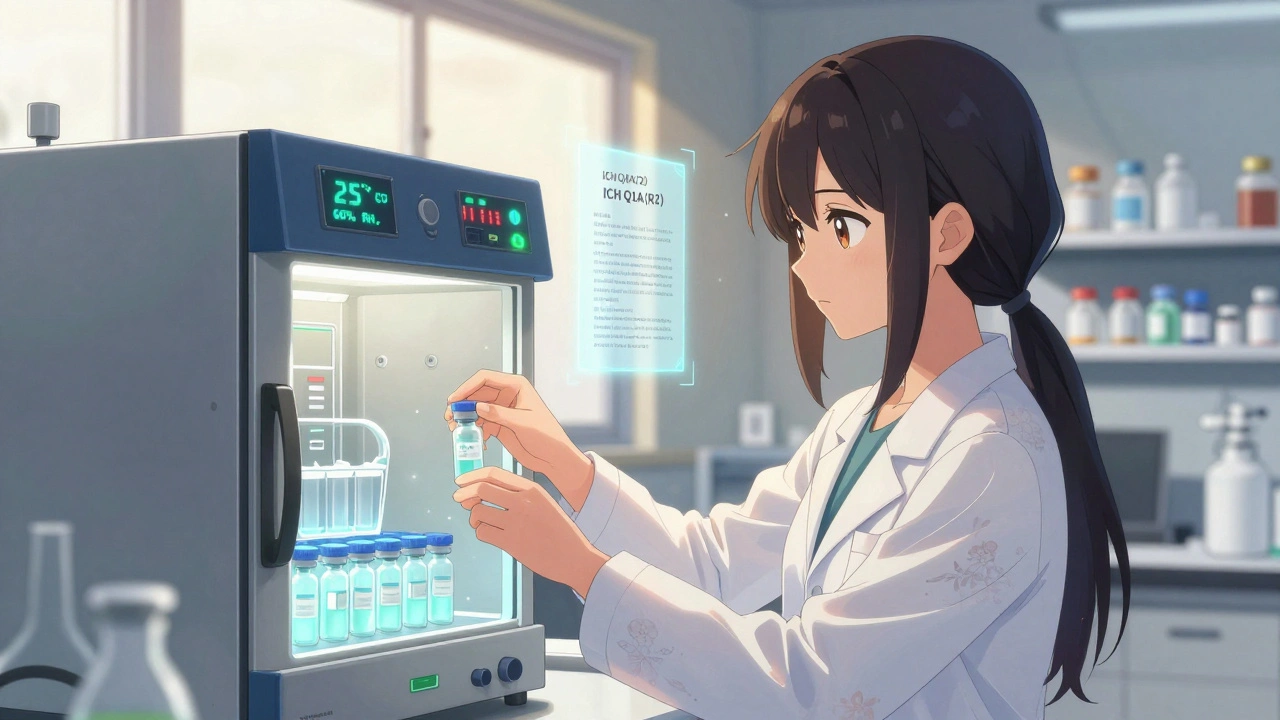
When a drug leaves the lab and enters the market, it must survive real-world conditions - heat, humidity, and time. Stability testing isn’t just paperwork; it’s the guardrail between a patient receiving a safe, effective medicine and one that’s broken down, weak, or even dangerous. The rules for how to test it are strict, global, and based on decades of science. If you’re working in pharma, quality control, or product development, understanding the exact temperature and time conditions for stability testing isn’t optional - it’s foundational.
Why Stability Testing Exists
Every pill, injection, or cream has a shelf life. But that shelf life isn’t guessed. It’s proven. Stability testing shows how a drug changes over time under controlled environmental stress. The goal? To make sure that when a patient opens a bottle six months or two years later, the medicine still works as intended. No more, no less.The system was built by the International Council for Harmonisation (ICH), a group formed in 1990 by regulators and industry from the U.S., Europe, and Japan. Their guideline, ICH Q1A(R2), published in 2003, is still the global standard today. The FDA, EMA, Health Canada, and others all follow it. Deviate from these conditions, and you risk regulatory action - warning letters, recalls, or even losing approval to sell your product. In 2022 alone, the FDA issued 27 warning letters tied to stability testing failures.
Long-Term Testing: The Real-Time Benchmark
Long-term testing is the gold standard. It’s what you use to set the official expiration date. The conditions are simple but precise:- 25°C ± 2°C with 60% RH ± 5% RH
- OR 30°C ± 2°C with 65% RH ± 5% RH
You pick one based on where your product will be sold. If your market is in a temperate region like the U.S. or Germany, 25°C/60% RH is typical. If you’re targeting tropical countries like India or Brazil, you go with 30°C/65% RH. The ICH divides the world into five climatic zones, and your choice must match your target market.
How long does it take? At least 12 months of data must be available when you submit your drug for approval. The FDA requires this. The EMA lets you submit with 6 months if you’re using a specific option, but 12 months is always safer for global approval. Testing doesn’t stop at 12 months - you keep going out to 24, 36, or even 60 months to confirm the shelf life.
Testing happens at fixed intervals: 0, 3, 6, 9, 12, 18, 24, and 36 months. Early time points catch fast-degrading products. Chambers must hold temperature within ±0.5°C and humidity within ±2% RH. Any drift outside those limits can invalidate your entire study.
Accelerated Testing: The Speed Test
You can’t wait three years to find out if your drug will last. That’s where accelerated testing comes in. It’s a stress test designed to predict long-term behavior in a fraction of the time.The global standard is clear:
- 40°C ± 2°C with 75% RH ± 5% RH for 6 months
This isn’t random. It was chosen because it’s hot enough to speed up degradation - but not so hot that it melts excipients or causes unnatural reactions. Experts say this condition roughly mimics 24 months of real-time storage at 25°C/60% RH for 85% of small-molecule drugs. But here’s the catch: it doesn’t work for everything.
Hygroscopic drugs - those that suck up moisture like a sponge - often fail this correlation. So do complex formulations like lipid nanoparticles used in mRNA vaccines. In those cases, accelerated testing can give false confidence. That’s why you can’t rely on it alone. It’s a warning sign, not a final answer.
Intermediate Testing: The Safety Net
Intermediate testing isn’t always required - but when it is, it’s critical. It kicks in when your accelerated test shows a “significant change” and your long-term study is run at 25°C, not 30°C.The condition? Exactly the same as accelerated testing:
- 30°C ± 2°C with 65% RH ± 5% RH for 6 months
This acts as a bridge. If your drug degrades under accelerated conditions but you’re storing it at 25°C long-term, intermediate testing tells you whether that degradation will still happen in real-world heat. Merck used this to catch a hidden polymorphic change in Keytruda® - a change that could’ve affected how the drug was absorbed in hot climates. Without intermediate testing, it might’ve slipped through.
Refrigerated Products: Different Rules
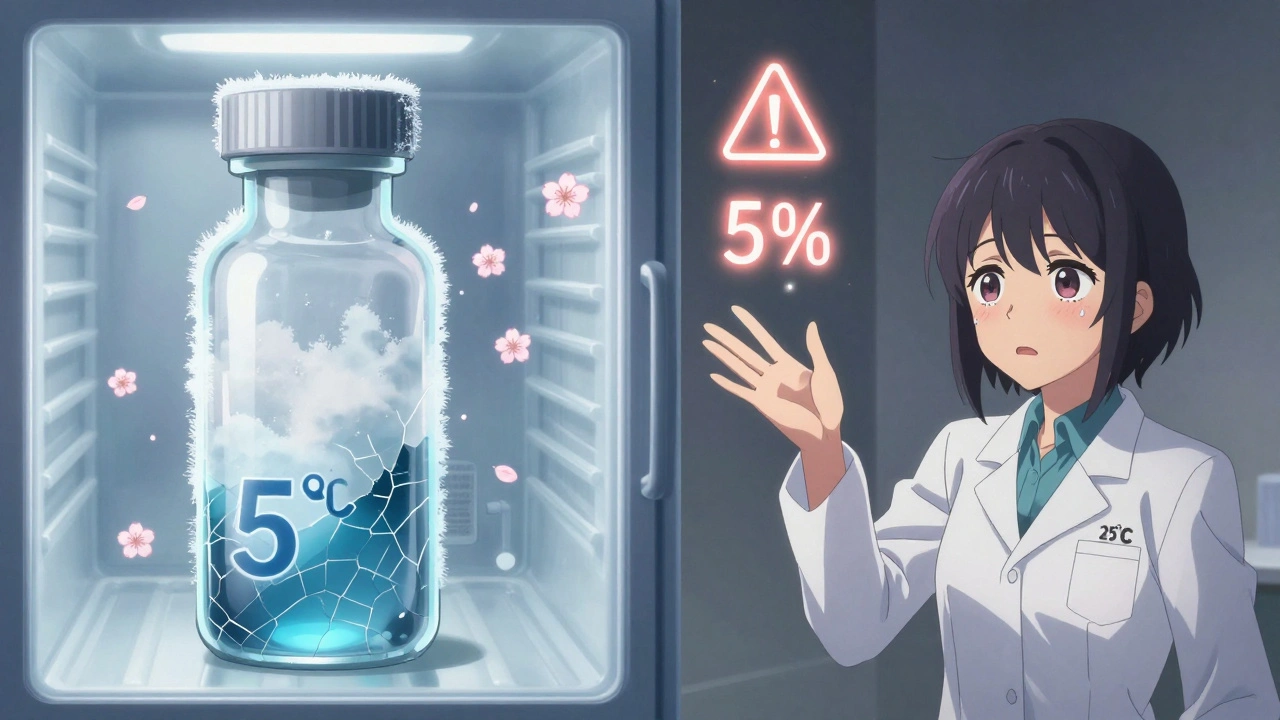
Not all drugs are stored at room temperature. Vaccines, biologics, and some injectables need refrigeration. Their stability rules are different.- Long-term: 5°C ± 3°C for 12 months
- Accelerated: 25°C ± 2°C with 60% RH ± 5% RH for 6 months
Notice: the accelerated test here is NOT 40°C. That’s because freezing and thawing are bigger threats than heat for these products. The 25°C condition simulates accidental warm exposure during shipping or storage. The WHO confirms this approach in its Annex 10 to ICH guidelines. If your product is refrigerated, don’t use the same accelerated protocol as a tablet.
What Counts as a “Significant Change”?
This is where things get messy. ICH Q1A(R2) says a significant change means:- A 5% change in assay
- Any degradation product exceeding its qualification threshold
- Failure to meet appearance, pH, or dissolution criteria
But here’s the problem: no one defines what “exceeding the threshold” means in practice. One regulator might reject a 4.8% assay drop. Another might accept it. Pfizer employees have reported regulatory battles over single-digit changes that were statistically insignificant. That subjectivity causes delays, retests, and sometimes recalls - like the 2021 case where Teva had to pull 150,000 vials of Copaxone® because aggregation wasn’t detected under accelerated conditions.

Challenges in Real-World Testing
Even with perfect guidelines, execution is hard. A 2023 survey of 142 stability professionals found that 78% had experienced a temperature excursion - meaning the chamber went outside ±2°C during a study. One excursion can ruin months of data.Humidity control is another headache. In dry climates, maintaining 60-75% RH requires extra humidifiers. In large chambers, temperature can vary by ±1.8°C from top to bottom. That’s why IQ/OQ/PQ qualification (Installation, Operational, Performance Qualification) isn’t optional. It takes weeks per chamber. And if you’re testing photostability? You need special light cabinets that meet ICH Q1B.
Documentation is massive. A single stability dossier can run 450-600 pages. Raw data, protocols, reports - all archived for years. And the wait? It’s brutal. 67% of companies report delays in product launches because stability data isn’t ready in time.
What’s Changing? The Future of Stability Testing
The ICH Q1A(R2) guidelines are 20 years old. Science has moved on. Biologics, mRNA vaccines, antibody-drug conjugates - these don’t degrade like aspirin. The current protocols weren’t built for them.Companies are already using predictive modeling. Some run tests at 50°C, 60°C, even 80°C to speed up results. The goal? Cut 9-12 months off development time. But regulators are skeptical. The EMA rejected eight model-based submissions in 2022-2023 because they couldn’t prove the models matched real-world behavior.
The FDA is running a pilot using real-time monitoring tools (PAT) for continuous manufacturing. If it works, future stability testing could be partly virtual - using data from the production line instead of waiting for shelf life to pass.
By 2030, McKinsey predicts 60% of stability data may come from modeling, not physical testing. But until regulators fully trust the math, you still need the chambers, the data points, and the 12-month wait.
Final Takeaway: Precision Matters
Stability testing isn’t about checking boxes. It’s about protecting patients. The temperature and time conditions aren’t suggestions - they’re the law. Get the 40°C/75% RH wrong, and you might miss a degradation pathway. Use the wrong humidity level, and your tablet crumbles in a humid warehouse. Skip intermediate testing, and your drug fails in a tropical market.The system is old, but it works - if you follow it exactly. The future may bring faster methods, but for now, your best defense is precision: calibrated chambers, documented protocols, and data that doesn’t cut corners.
What are the standard temperature and humidity conditions for long-term stability testing?
The two accepted long-term conditions are 25°C ± 2°C with 60% RH ± 5% RH, or 30°C ± 2°C with 65% RH ± 5% RH. The choice depends on the climatic zone of the target market. For example, Zone II (subtropical) uses 25°C/60% RH, while Zone IVa (hot-humid) uses 30°C/65% RH. At least 12 months of data must be available at submission for global approval.
How long should accelerated stability testing last?
Accelerated testing must last 6 months at 40°C ± 2°C and 75% RH ± 5% RH. This is the global standard under ICH Q1A(R2) for all non-refrigerated products. It’s designed to simulate 24 months of real-time storage under normal conditions, though this correlation doesn’t hold for hygroscopic or biologic products.
When is intermediate testing required?
Intermediate testing is required only if accelerated testing shows a significant change and the long-term study is conducted at 25°C instead of 30°C. The condition is 30°C ± 2°C and 65% RH ± 5% RH for 6 months. It helps bridge the gap between accelerated results and real-world storage, especially for products destined for hot climates.
What are the stability conditions for refrigerated products?
Refrigerated products are tested at 5°C ± 3°C for long-term storage. Accelerated testing is done at 25°C ± 2°C and 60% RH ± 5% RH for 6 months - not 40°C. This reflects the real risk for these products: accidental warming during transport or storage, not extreme heat.
Why do stability test failures lead to recalls?
Stability failures mean the drug has degraded beyond acceptable limits - potency drops, impurities rise, or physical properties change. A tablet that crumbles or a solution that turns cloudy can be ineffective or harmful. Regulatory agencies like the FDA require proof that a product remains safe and effective throughout its shelf life. If testing shows it doesn’t, the product must be recalled to protect public health.
Can predictive modeling replace physical stability testing?
Some companies use predictive models to reduce testing time, but regulators still require physical data for approval. While 74% of top pharma companies use accelerated predictive studies, agencies like the EMA have rejected model-only submissions. For now, physical testing remains mandatory - but future guidelines may allow hybrid approaches using real-time process data.
Ignacio Pacheco
So let me get this straight - we spend millions on chambers that hold temperature to ±0.5°C, but the guy in Mumbai who buys this drug? He’s got it sitting on a windowsill above his stove for three months. And we’re surprised when it turns to sludge?
Stability testing is less science and more theater. We check the boxes so the FDA doesn’t slap us, but no one’s auditing the supply chain from warehouse to bedside.
It’s like putting a seatbelt on a spaceship while the rocket’s held together with duct tape.