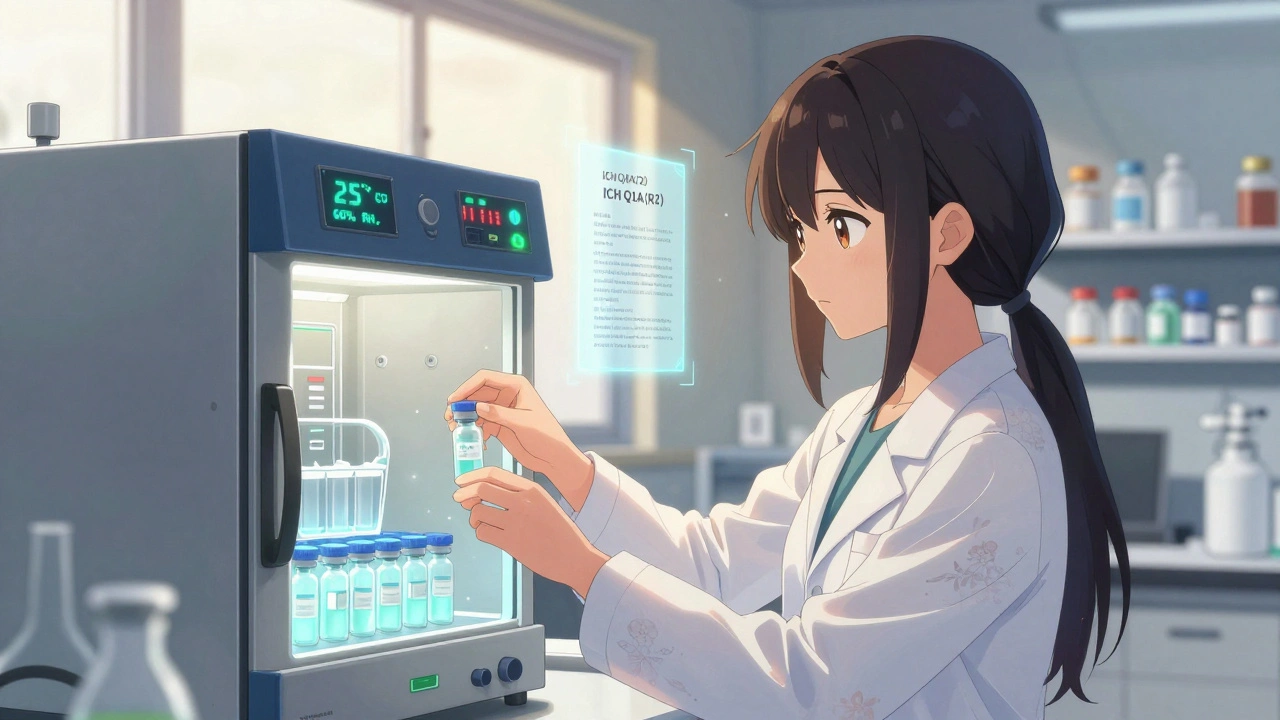
When you pick up a bottle of pills, you assume they’ll work the same way next year as they do today. That’s not luck—it’s because of ICH Q1A(R2), a global regulatory guideline that defines how pharmaceutical companies must test and prove a drug stays stable under real-world conditions. Also known as ICH Q1A(R2) Guideline for Stability Testing of New Drug Substances and Products, it’s the rulebook that ensures your medicine doesn’t break down before you take it. Without ICH Q1A(R2), drugs could lose potency in hot climates, degrade in humidity, or become unsafe over time—and no one would know until someone got sick.
ICH Q1A(R2) doesn’t just say "test your drug." It tells you exactly how: what temperatures, humidity levels, and light conditions to use, how long to test (typically 12, 24, 36 months), and what data to collect. It applies to everything from insulin pens to antibiotics, and it’s followed by every major regulator—FDA, EMA, Health Canada, PMDA. If a drug doesn’t meet ICH Q1A(R2), it doesn’t get approved. That’s why you see expiration dates on bottles, and why manufacturers store samples in climate-controlled rooms. This isn’t paperwork—it’s patient safety.
Related to ICH Q1A(R2) are the tools and methods used to measure stability: drug degradation, the chemical breakdown of active ingredients over time, and pharmacovigilance, the monitoring of drug safety after approval. If a drug degrades faster than predicted under ICH Q1A(R2), it can trigger recalls or safety alerts—like those tracked through systems like FAERS or Sentinel. And it’s not just about the pill itself. Packaging matters too. Light-sensitive drugs need amber bottles. Humidity-prone meds need desiccants. These aren’t afterthoughts—they’re built into the ICH Q1A(R2) testing plan.
Behind every approved generic or biosimilar is a stability study that followed ICH Q1A(R2). That’s why FDA approval timelines for generics—like the ones covered in our posts on generic drug approval—depend heavily on whether the company submitted complete stability data. The same goes for travel-friendly meds: if your HIV drug or insulin can’t handle tropical heat, it fails ICH Q1A(R2) standards, and you risk taking ineffective medicine abroad. Even storage tips for eye drops or light-sensitive drugs tie back to these rules.
You won’t find ICH Q1A(R2) mentioned on your prescription label, but it’s the invisible force behind every drug’s shelf life, storage instructions, and safety record. Whether you’re a patient checking expiration dates, a caregiver managing senior meds, or a professional working in pharma, this guideline affects you. Below, you’ll find real-world examples of how ICH Q1A(R2) connects to drug shortages, storage mistakes, biosimilar approvals, and even jet lag meds—all grounded in the same science that keeps your medicine working, no matter where you are or how long it sits on the shelf.