
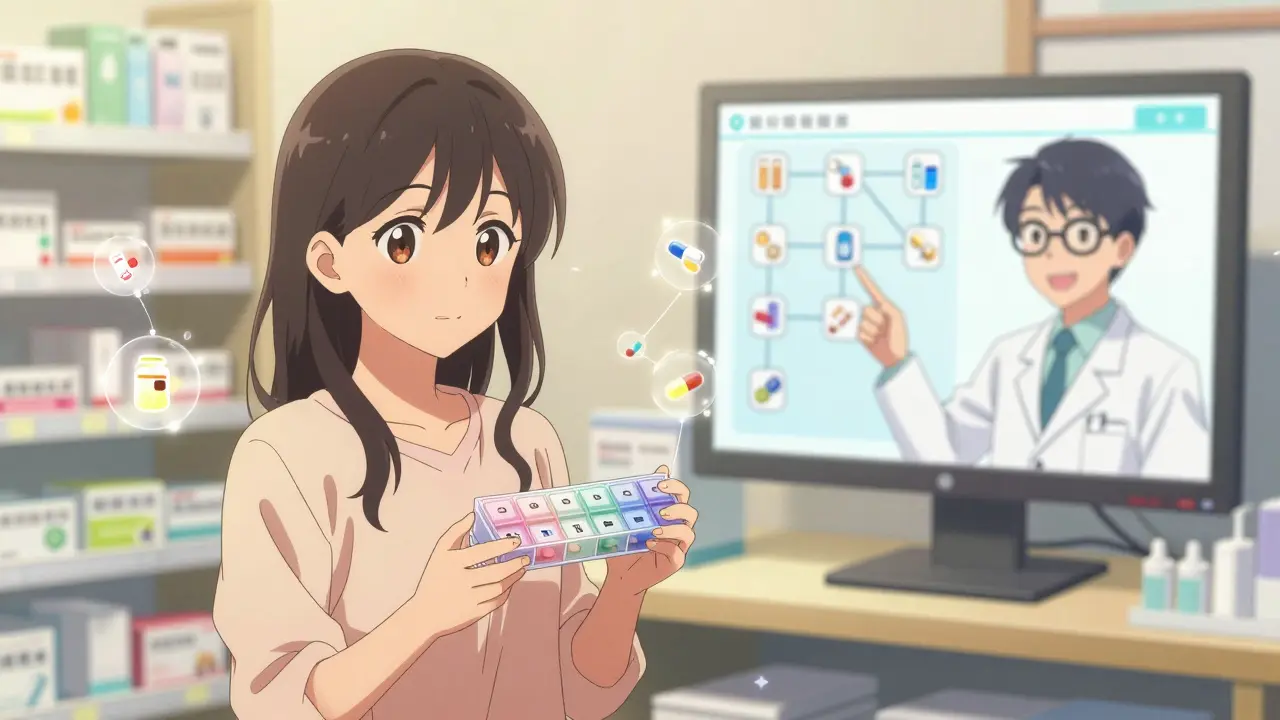
Medication Safety Calculator
Your Medication Risk Assessment
Enter how many prescription medications you currently take
Drug Interaction Risk
Risk with multiple pharmacies:
34% higher risk
A single pharmacy's system flags dangerous combinations like warfarin and NSAIDs
Medication Adherence
With medication synchronization:
85-90% adherence rate
Pharmacists coordinate refills to avoid missed doses and simplify schedules
Critical Safety Benefits
7% risk with multiple pharmacies
0.3% risk with one pharmacy
41% missed doses with multiple pharmacies
85-90% adherence with Med Sync
Pharmacists notice patterns before serious issues
Reduces hospitalizations from adverse events
When you take multiple medications, every pill matters. Miss one, mix two incorrectly, or get a new prescription from a different pharmacy - and you could be risking your health without even knowing it. That’s why using one pharmacy for all your prescriptions isn’t just convenient. It’s a proven safety strategy that cuts down dangerous drug interactions, prevents duplicate prescriptions, and gives you a pharmacist who truly knows your full medication picture.
Why One Pharmacy Makes a Real Difference
Think about this: if you fill your blood pressure pills at one pharmacy, your diabetes meds at another, and your pain relievers at a third, no single pharmacist has the full picture. But when all your prescriptions go through one location, that pharmacist sees everything. They catch conflicts before they happen. They notice if you’re getting two different pills with the same active ingredient. They remember you’re allergic to a certain dye or that your kidney function has changed.
According to a 2014 study published in the Journal of Managed Care & Specialty Pharmacy, patients who use multiple pharmacies face a 34% higher risk of dangerous drug interactions compared to those who stick with one. One of the most common and deadly combinations? Warfarin (a blood thinner) and NSAIDs like ibuprofen. Together, they can cause severe internal bleeding - a risk that jumps five times higher than warfarin alone. A single pharmacy’s system flags this instantly. Multiple pharmacies? The alerts get ignored, missed, or overridden because the pharmacist doesn’t have the full context.
How Medication Synchronization (Med Sync) Works
One of the smartest tools built around using one pharmacy is called medication synchronization, or med sync. It’s not just about refills - it’s about control. With med sync, your pharmacy coordinates all your prescriptions to be ready on the same day each month. So instead of running to the pharmacy every few weeks for different meds, you pick up everything at once.
Here’s how it works in practice:
- You start with a 15- to 20-minute consultation with your pharmacist.
- They review every prescription, over-the-counter drug, supplement, and herbal product you take - including what you’re not taking anymore.
- They adjust refill dates by giving you short-term fills if needed, so everything lines up.
- From then on, you get a call or text when everything’s ready - usually on the same day each month.
Pharmacies like CVS and Walgreens have been using this system for years. Internal data from 2022 shows adherence rates of 85-90% among patients enrolled in med sync. That means people are taking their meds as prescribed - a huge win for chronic conditions like diabetes, heart disease, or depression.
What You’re Protected From
Using one pharmacy doesn’t just help with interactions. It stops three other common dangers:
- Therapy duplication: Taking two different pills with the same active ingredient (like acetaminophen in both a cold medicine and a pain reliever). This happens in about 7% of people using multiple pharmacies - but drops to just 0.3% with one pharmacy.
- Missed doses: A 2022 survey by Avalon Pharmacy found that 41% of people juggling multiple pharmacies missed at least one dose per month. Confusion over schedules is the main reason.
- Overlooked side effects: Your pharmacist notices if you’re feeling dizzy, nauseous, or unusually tired. With consistent contact, they can spot patterns and adjust your regimen before things get serious.
There are real stories behind the numbers. The Cleveland Clinic documented a patient hospitalized with serotonin syndrome after two different pharmacies filled antidepressants that shouldn’t have been taken together. That kind of error rarely happens when one pharmacist is watching everything.
What About Cost? Isn’t It Cheaper to Shop Around?
Yes, some people switch pharmacies to save money. SingleCare’s 2023 analysis found that 63% of patients use multiple pharmacies to find lower prices - potentially saving $150-$300 a year. But here’s the trade-off: using multiple pharmacies increases your risk of an adverse drug event by 27%, according to the same 2014 study. And each of those events costs an average of $8,750 in hospital care, as reported by the Agency for Healthcare Research and Quality.
Many pharmacies now offer price-matching or discount programs for med sync patients. Some even waive delivery fees or offer free medication reviews. Ask your pharmacist: they may be able to find a lower price on your most expensive drug - without you having to go elsewhere.
How to Make the Switch
Switching to one pharmacy takes effort, but it’s easier than you think. Here’s a simple 4-step plan:
- Choose your pharmacy: Pick one that’s convenient and offers med sync. Chain pharmacies (CVS, Walgreens, Rite Aid) and many independent ones do.
- Gather your list: Write down every medication - including OTC drugs, vitamins, and supplements. Don’t forget the ones you stopped taking last year.
- Call or visit: Ask them to transfer all your prescriptions. This usually takes 2-5 business days. Bring your list with you.
- Enroll in med sync: Schedule your first comprehensive review. This is where your pharmacist gets to know your full story.
Most patients complete the transition in 2-4 weeks. After that, you’ll get reminders, fewer trips to the pharmacy, and peace of mind.
Who Benefits the Most?
This isn’t just for older adults. While 15% of U.S. adults take five or more prescriptions, younger people with chronic conditions - diabetes, autoimmune diseases, mental health disorders - are just as vulnerable. A 2022 article from the Diabetes Care Community found that patients managing diabetes with multiple medications had far fewer errors when they used one pharmacy. Why? Because their pharmacist could see how insulin, blood pressure meds, and cholesterol drugs interacted - not just one at a time.
Even if you’re on just three or more medications, the data says you’re better off with one pharmacy. Reddit’s r/Pharmacy community saw 68% of 142 respondents recommend consolidating for anyone on three or more prescriptions.
The Bigger Picture
The healthcare system is slowly catching on. In 2023, the Pharmacy Quality Alliance made comprehensive medication reviews a key performance metric. The Centers for Medicare & Medicaid Services (CMS) is now offering incentives to pharmacies that hit 90%+ med sync rates. And by 2025, researchers at the University of Southern California plan to launch an AI tool that helps pharmacists predict which medication combinations are safest for each individual.
For now, the best tool you have is simple: one pharmacy. One pharmacist. One clear view of your meds. It’s not magic. It’s just smart.
Is it safe to use one pharmacy if I have a lot of prescriptions?
Yes - in fact, the more prescriptions you take, the more important it is. People on five or more medications have a 15% higher risk of dangerous interactions, according to the University of Southern California. A single pharmacy’s system flags every possible conflict, while multiple pharmacies leave gaps in the safety net. Pharmacists can also recommend combination pills or adjust doses to simplify your regimen.
Can I still use my insurance if I switch pharmacies?
Absolutely. Your insurance works the same way regardless of which pharmacy you use. Most major insurers have contracts with national chains and many independent pharmacies. Just make sure the pharmacy you choose is in-network. Your pharmacist can check this for you during the transfer process.
What if I don’t trust my local pharmacy?
You have the right to choose. Try a different pharmacy - even one in a nearby town. Look for one that offers med sync and seems willing to spend time explaining your meds. Many independent pharmacists build long-term relationships and know their patients by name. Ask if they do home delivery or offer free medication reviews. Don’t settle for a pharmacy that treats you like a transaction.
Do I need to tell my doctor I’m switching pharmacies?
It’s not required, but it helps. Your doctor can send a copy of your medication list to the new pharmacy. Some electronic health records (like Epic and Cerner) now share medication histories across providers, but not all systems talk to each other. Bringing your own list - even if you think you’ve told your doctor - makes the transition smoother and safer.
How often should I review my medications?
At least once a year - but ideally every time you refill. Many pharmacies offer free medication reviews during your monthly med sync visit. Use this chance to ask: "Is everything I’m taking still necessary?" "Are there cheaper or safer alternatives?" "Could any of these be causing my side effects?" These conversations prevent long-term harm.
Rachele Tycksen
i just started using one pharmacy last year and honestly? life changed. no more running around like a headless chicken. my pharmacist remembers my cats, my allergies, and that i hate taking pills with food. it’s wild how much simpler everything is.