

Living with vitiligo means more than just dealing with patches of lighter skin. For many, it’s the daily worry about stares, comments, or feeling out of place in social settings. The good news? You don’t have to live with that weight. Vitiligo camouflage isn’t about hiding who you are-it’s about giving yourself the freedom to show up without fear. Whether you’re just starting out or have tried everything, there are real, effective options that work.
What Vitiligo Camouflage Actually Does
Vitiligo camouflage isn’t makeup you grab off the drugstore shelf. It’s a medical-grade solution designed specifically for skin that’s lost pigment. Unlike regular foundation, these products contain up to 25% more pigment to match the color of unaffected skin. They’re tested under real-world conditions-sweat, water, sunlight-and built to last. The goal? To restore a natural, even skin tone so you can move through your day without constant self-consciousness.
According to dermatologists like Dr. Madhulika Upadhyay, the psychological shift is immediate. Patients who use camouflage regularly report up to a 35% improvement in their Dermatology Life Quality Index (DLQI) scores. That’s not just about looks-it’s about confidence, social interaction, and reclaiming normalcy.
Temporary Camouflage: Daily Solutions That Work
Most people start with temporary camouflage. These are products you apply every morning, like a moisturizer or foundation. They’re safe, reversible, and perfect for testing what works before considering permanent options.
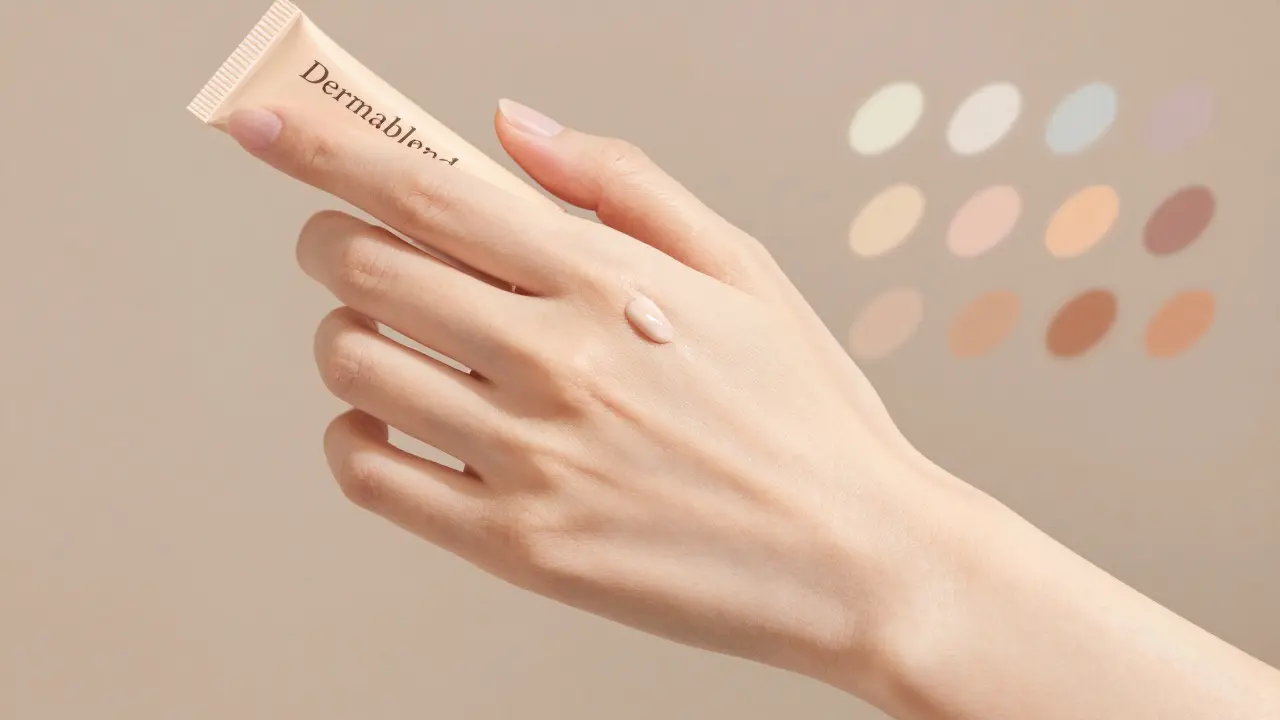
- Water-based formulas are ideal for normal to dry skin. They feel light, blend easily, and set in about 90 seconds. Brands like Dermablend and Dermacolour use this base.
- Oil-free formulas use dimethicone or cyclomethicone to repel sweat and oil. Great for oily skin or hot climates. They don’t clog pores or feel greasy.
- Anhydrous (water-free) formulas are waterproof. They contain waxes, mineral oils, and synthetic esters. These are the go-to for lips, hands, or areas that get wet often. They take 3-5 minutes to set but last 12-14 hours.
Real users report that Dermablend scores 4.6 out of 5 for color matching. Why? It has over 20 shades designed specifically for vitiligo. A 2023 survey of 347 members of the Vitiligo Society showed 82% satisfaction with foundation-based products. The key? Finding your match under natural daylight-not indoor lighting.
How to Apply Camouflage Like a Pro
Applying camouflage isn’t like putting on regular foundation. It’s a skill. Most people need 2-4 weeks of daily practice to get it right.
- Start with clean skin. Use a pH-balanced cleanser. Avoid oil-based cleansers-they can interfere with pigment adhesion.
- Match under natural light. Stand near a window. Hold the product next to your skin. Don’t rely on screen lighting or bathroom mirrors.
- Apply in thin layers. Start with a small amount. Build up slowly. Thick layers crack or look mask-like.
- Wait between layers. Water-based needs 90 seconds. Anhydrous needs 3-5 minutes. Rushing this step causes patchiness.
- Set with powder. Use a translucent, non-tinted powder to lock it in. Avoid colored powders-they alter the shade.
Many users say the hardest part is color matching. That’s why certified consultants exist. The Vitiligo Society reports that 89% of patients achieve good results after one personalized training session. You don’t have to figure it out alone.
Self-Tanners: A Double-Edged Sword
Self-tanning lotions are tempting. They last days and cost less. But they’re risky for vitiligo.
Depigmented skin doesn’t tan. So when you apply self-tanner, the dark areas darken, but the white patches stay pale. The result? A streaky, uneven look that draws more attention than before. Some people use it as a stopgap, but it’s not a reliable solution. If you try it, use a small amount, blend aggressively, and reapply every 2-3 days. Even then, it’s not a long-term fix.
Permanent Camouflage: Micropigmentation Explained
If you’re tired of daily application, micropigmentation (also called cosmetic tattooing) is an option. It’s not a tattoo-it’s a medical procedure using sterile needles to implant inert iron oxides into the dermis.
Here’s how it works:
- Pigment particles are 6 microns in size-small enough to stay stable, large enough to avoid toxicity.
- Technicians place pigment between the superficial and middle dermis, at 15-20 punctures per square centimeter.
- Over 15 hues are available, matched precisely to your skin tone.
- Each session lasts 45-90 minutes. You need 2-3 sessions, spaced 6-8 weeks apart.
But there are strict rules. The Vitiligo Society and the Dermopigmentation Center in Marbella agree: your vitiligo must be stable for at least 12 months. If it’s still spreading, the pigment can look wrong as new patches appear. In fact, 18% of unstable cases developed a “halo effect”-a ring of lighter skin around the tattooed area.
Results vary by body part:
- Face, lips, wrists, elbows: High success rate. Pigment lasts 2-5 years.
- Hands, feet, knuckles: Fades 40% faster due to friction and movement. Touch-ups needed every 12-18 months.
Costs range from $300 to $800 per session, depending on size and location. NUE Conceal’s 2023 data shows 74% satisfaction for facial treatments versus 48% for hands. One Reddit user, u/VitiligoWarrior, described lip micropigmentation as “life-changing” after 15 years of hiding. Another, u/Sunshine789, had uneven fading on knuckles and needed two touch-ups in 8 months.

What Doesn’t Work (And Why)
Some home remedies are still floating around. Henna, potassium permanganate, Loha Bhasma (iron filings), and Suvarna Karini (clay + henna) are common. But they’re unreliable.
A 2022 survey found only 32% of users were satisfied. Why? These aren’t designed for skin tone matching. They stain unevenly, wash off in hours, and can irritate sensitive skin. They’re not medical-grade. Stick to products designed for vitiligo.
Cost, Convenience, and What’s Next
The global cosmetic camouflage market hit $1.27 billion in 2022. Vitiligo-specific products make up 18% of that. North America leads, but Asia-Pacific is growing fastest.
Cost is a real barrier. Premium products run $25-$45 each. A single jar might last 2-3 months with daily use. Some insurance plans cover camouflage if prescribed by a dermatologist. Ask your provider.
Looking ahead, AI is stepping in. L’Oréal’s ModiFace app is in beta testing for Dermablend. It uses your phone camera to match your skin tone in real time. Expected in Q2 2024, it could cut color-matching time from hours to minutes.
Dr. Nithya Krishnaswamy predicts a 30% rise in permanent camouflage use over the next five years. But she stresses: camouflage is not a cure. It’s a companion to medical treatments like phototherapy or topical steroids.
Final Thoughts: You Have Choices
Vitiligo doesn’t define you. But the way you feel about it? That matters. Whether you choose daily camouflage, micropigmentation, or a mix of both, the goal is the same: to help you feel like yourself again. Start with a dermatologist who specializes in pigment disorders. Try a sample kit. Talk to others in support groups. You’re not alone-and you don’t have to cover up your skin to be seen.
Can I use regular foundation to camouflage vitiligo?
Regular foundation won’t work well. It lacks the pigment density needed to cover depigmented patches. Most users report patchy, translucent coverage. Medical-grade camouflage products like Dermablend or Dermacolour contain up to 25% more pigment and are formulated to resist sweat, water, and rubbing. Stick to products designed specifically for vitiligo.
How long does vitiligo camouflage last?
Temporary camouflage lasts 6-14 hours, depending on the formula. Water-based products fade faster with sweat or washing, while anhydrous (waterproof) formulas last up to 14 hours. Self-tanners last 4-7 days but often look uneven on vitiligo. Permanent micropigmentation lasts 2-5 years on stable skin, though areas like hands and feet may need touch-ups every 12-18 months.
Is micropigmentation safe for vitiligo?
Yes-but only if your vitiligo has been stable for at least 12 months. If the condition is still spreading, the tattooed pigment may not match new patches, leading to a halo effect. Always consult a dermatologist with micropigmentation experience. Avoid clinics that don’t screen for disease activity. The pigment used is inert iron oxide, not organic dyes, making it biocompatible and non-toxic.
What’s the best product for vitiligo on the face?
Dermablend’s Cover Creme and Dermacolour’s Foundation are top-rated for facial use. Both offer high pigment density, SPF 2-3 protection, and 12+ hour wear. They come in 20+ shades matched to diverse skin tones. For oily skin, choose oil-free versions. For dry skin, water-based formulas work best. Always test shades under natural light before buying full size.
Can I use camouflage with other vitiligo treatments?
Absolutely. In fact, dermatologists recommend combining camouflage with medical treatments like phototherapy or topical steroids. Camouflage gives you immediate confidence while longer-term therapies take effect. There’s no interaction between the two. Just apply camouflage after your topical treatment has fully absorbed, and avoid applying it over open lesions or inflamed skin.
For those considering micropigmentation, clinics like NUE Conceal and the Dermopigmentation Center in Marbella offer free consultations. Many now include virtual color matching via video call-a helpful step if you’re unsure where to start.
Mandy Vodak-Marotta
Okay but let’s be real-Dermablend is basically magic in a tube. I’ve been using it for 5 years now, and I still get stopped by strangers asking if I got a new tan. Not the kind of attention you want, but hey, at least they’re not staring at my patches. The key is layering super thin and setting with translucent powder. I used to ruin entire jars by going too heavy, but now? I look like I just woke up with perfect skin. No one knows. And honestly? That’s the win.
Also, DO NOT use self-tanner. I tried it once after a bad day and looked like a zebra that got into a paint factory. My cat ran away. Not exaggerating.
And yes, natural light is non-negotiable. My bathroom mirror is a liar. Windows only.
Also, if you’re new to this, start with a sample kit. Don’t drop $40 on a shade that looks like burnt toast next to your skin. I learned the hard way.
Also also, micropigmentation is NOT for everyone. I considered it, but my vitiligo still creeps a little. I’d rather have a 12-hour mask than a lifetime of regret.
Also also also, L’Oréal’s ModiFace app sounds like the future. I’m already waiting for it like it’s the next iPhone. Bring it on.
Also also also also-please tell your dermatologist you want a camouflage prescription. Insurance might cover it. I got mine covered after a 3-hour phone call and three forms signed in blood. Worth it.
Also also also also also-support groups are life. I cried in my first meeting. Then I laughed. Then I bought a whole new set of foundation. You’re not alone, seriously.
Also also also also also also-I still have bad days. But now I have tools. And that’s everything.