
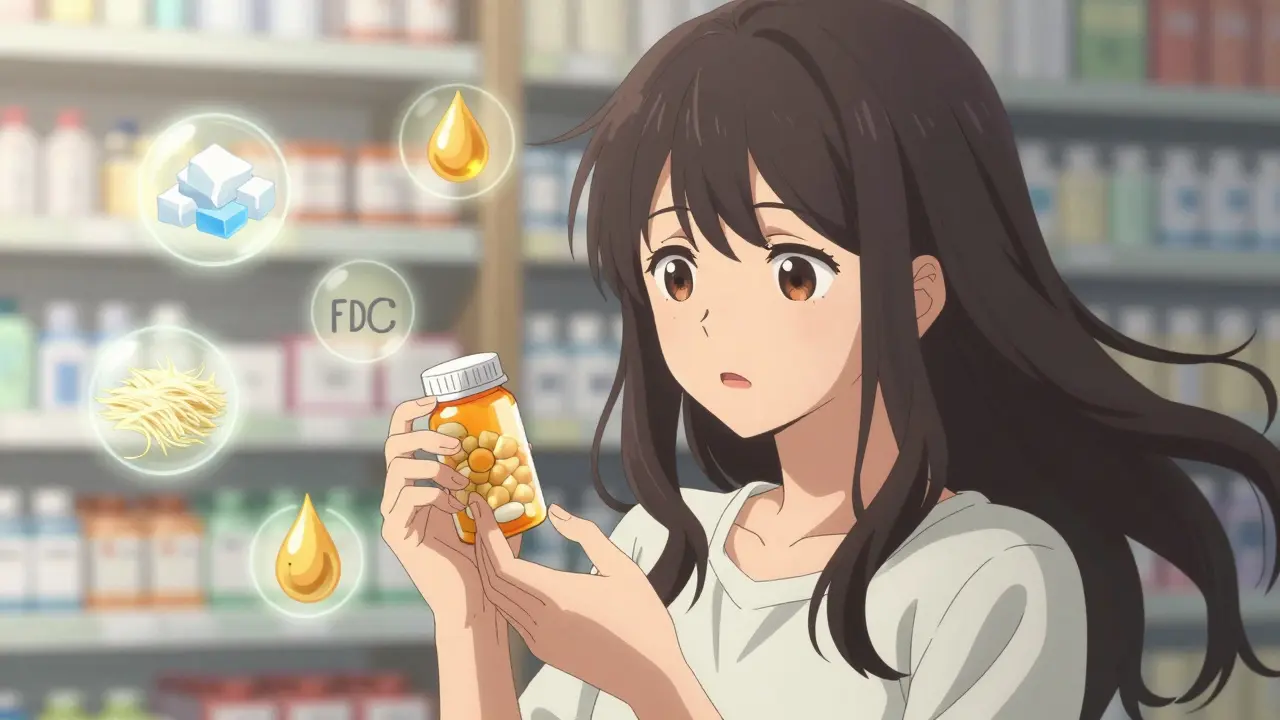
When you pick up a prescription, you might assume that a generic drug is just a cheaper version of the brand-name one - and for the most part, you’re right. The active ingredient is identical. But here’s the part no one talks about: inactive ingredients can make a real difference in how your body reacts. These are the fillers, dyes, preservatives, and binders that make up most of the pill - sometimes over 90% of it. And while they don’t treat your condition, they can trigger side effects you never saw coming.
What Are Inactive Ingredients?
Inactive ingredients - also called excipients - are the non-drug parts of a medication. They help the pill hold its shape, dissolve at the right speed, taste better, or last longer on the shelf. Think of them like the ingredients in a cake: sugar, flour, and butter aren’t the main flavor, but they still matter. In a typical tablet, the active drug might be just 5-10% of the total weight. The rest? Lactose, cornstarch, titanium dioxide, FD&C dyes, or even peanut oil.
The FDA allows these ingredients as long as they’re generally recognized as safe. But “safe” doesn’t mean “safe for everyone.” A 2019 study from MIT and Brigham and Women’s Hospital found that 93% of medications contain at least one substance that can trigger reactions in sensitive people. That includes lactose, gluten, bisulfites, and FODMAP sugars. For someone with celiac disease, a single pill with hidden gluten can cause serious gut damage. For someone with asthma, sodium metabisulfite can trigger an attack.
Why Do Generic Drugs Have Different Inactive Ingredients?
Generic drug makers aren’t required to copy the exact formula of the brand-name version. They only need to prove their drug delivers the same amount of active ingredient into your bloodstream at the same rate. That’s called bioequivalence. But how they get there? That’s up to them.
One brand-name drug might use lactose as a filler. A generic version might use microcrystalline cellulose instead. Another generic might use a different dye to make the pill look different - not to confuse you, but to avoid trademark issues. The problem? You might switch from one generic to another, or from brand to generic, and suddenly feel off. Your stomach cramps. Your skin itches. Your head pounds. You didn’t change your dose. You just changed the filler.
Research from Harvard Health showed that after generic versions of blood pressure drugs like losartan and valsartan hit the market, reports of adverse events jumped by 8-14%. While scientists aren’t sure if it was the inactive ingredients or something else, the timing lines up. And patients? They notice. One Reddit user reported severe stomach cramps after switching from Synthroid to generic levothyroxine - symptoms vanished when they went back.
Who’s at Risk?
You don’t need to have a rare condition to be affected. Here are common culprits and who should pay attention:
- Lactose - Found in about 20% of oral medications. If you’re lactose intolerant, even a small amount can cause bloating, gas, or diarrhea.
- Gluten - Not always listed. Some generic pills use wheat starch as a binder. For people with celiac disease, this is dangerous.
- Bisulfites - Used as preservatives. Can trigger asthma attacks. Often labeled, but not always.
- FODMAP sugars - Like fructose or sorbitol. These can trigger IBS flare-ups. About 55% of medications contain them.
- Dyes (FD&C Red 40, Blue 1, etc.) - Linked to skin rashes and hyperactivity in sensitive individuals.
- Peanut oil - Rare, but used in some liquid or topical meds. Always labeled, but easy to miss.
People over 65 are especially vulnerable. The MIT study found that 30% of seniors take five or more medications daily. That means they’re exposed to a cocktail of inactive ingredients - and the more you take, the higher the chance one of them will cause a problem.
How to Find Out What’s in Your Pill
Here’s the frustrating part: drug labels rarely list inactive ingredients clearly. The FDA maintains an Inactive Ingredient Database, but it’s designed for pharmacists and scientists - not patients. It’s full of chemical names like “hypromellose” or “magnesium stearate.”
So what can you do?
- Ask your pharmacist - They have access to detailed formulation sheets. Just ask: “What are the inactive ingredients in this generic?”
- Check the manufacturer’s website - Most drug companies list full ingredient lists on their product pages.
- Use the FDA’s DailyMed database - Search your drug name there. You’ll get the full prescribing information, including inactive ingredients.
- Keep a list - If you’ve had a reaction to a generic, write down the name, manufacturer, and what you think caused it. Bring it to your next appointment.
Some pharmacies even offer special-order generics with hypoallergenic formulations - especially for patients with multiple sensitivities. It might cost a little more, but it could save you from a hospital visit.
When to Stick With Brand-Name
Most people switch to generics without issue. But if you’ve had unexplained side effects after switching - nausea, rashes, headaches, fatigue - don’t just assume it’s “in your head.”
According to the Merck Manual, if you have a known allergy or intolerance, a generic may not be appropriate. If your doctor wrote “Dispense as Written” or “Do Not Substitute” on your prescription, that’s a signal. It means they’ve seen this before - maybe with another patient - and they know the generic might not work for you.
Also, for drugs with a narrow therapeutic index - like thyroid meds (levothyroxine), blood thinners (warfarin), or seizure drugs (phenytoin) - even tiny changes in absorption can matter. That’s why some doctors prefer to keep patients on the same brand.
What’s Being Done?
Researchers at MIT are building a public database that links inactive ingredients to specific medications, so patients and doctors can see what’s in each pill before prescribing. The FDA is reviewing whether to require clearer labeling for common allergens - even if they’re not required to be labeled under current rules.
Some generic manufacturers are starting to offer “clean label” versions - no dyes, no gluten, no lactose. These aren’t yet mainstream, but they’re growing. In the future, you might see generic drugs labeled as “hypoallergenic” or “gluten-free” - just like food.
The Bottom Line
Generic drugs save billions of dollars every year. They’re safe for most people. But they’re not all the same. The active ingredient might match - but the rest of the pill? That’s where the real variability lies.
If you’ve ever felt strange after switching to a generic - even if it was just a little off - you’re not imagining it. Talk to your pharmacist. Ask questions. Don’t be afraid to ask for the brand if it matters to your health. And if you take multiple medications, especially as you get older, take a moment to check what’s in each one. Your body might be reacting to something you never knew was there.
Gretchen Rivas
I'm a pharmacist and I can't tell you how many patients come in saying 'I feel weird since I switched generics.' Turns out, it's often the lactose or the dye. Always ask for the full ingredient list - your pharmacist has it. Simple fix, huge difference.