
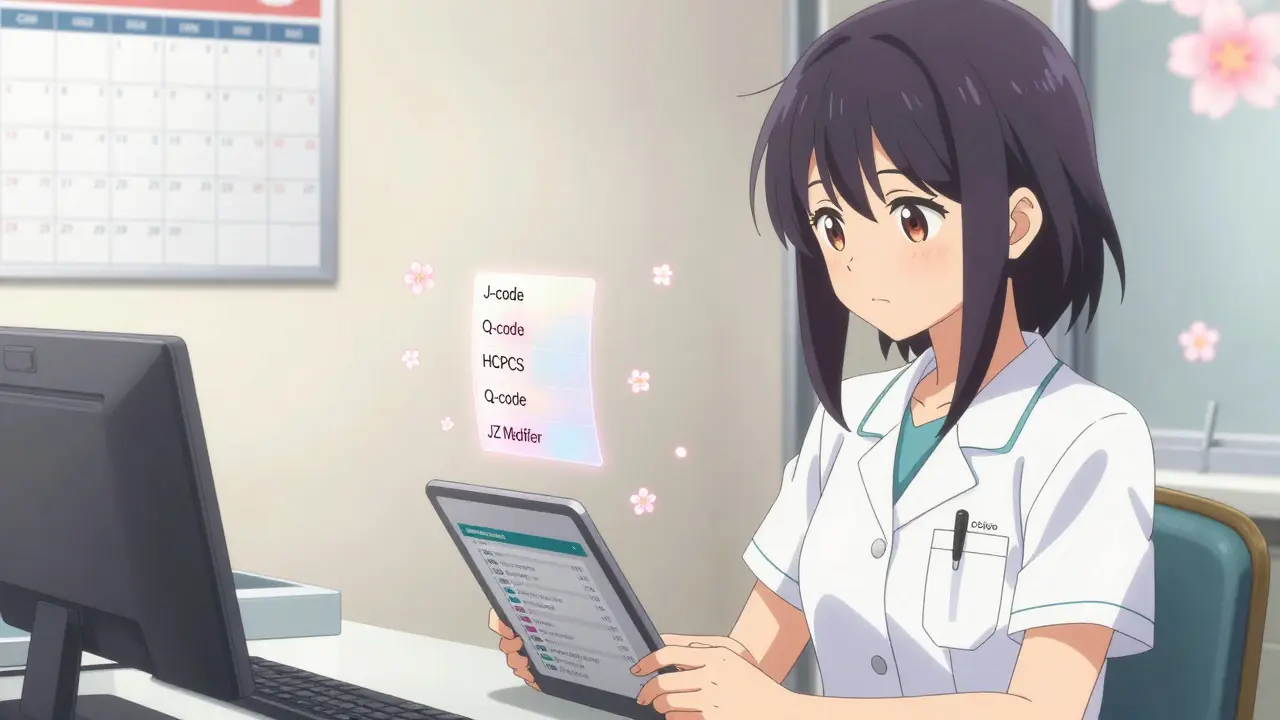
When a doctor gives you a biosimilar instead of the original biologic drug, the billing process isn’t as simple as switching one pill for another. Unlike generic small-molecule drugs, biosimilars are complex biological products made from living cells. Their reimbursement under Medicare Part B follows a unique, highly technical system that affects everything from provider profits to how fast these cheaper alternatives reach patients.
How Biosimilars Are Coded Differently Than Generics
Biosimilars don’t use the same coding system as traditional generics. You won’t find them listed under standard J-codes like J0123 for a generic antibiotic. Instead, each FDA-approved biosimilar gets its own unique HCPCS code-either a temporary Q-code or a permanent J-code. This is a critical difference from generic drugs, where all versions of the same chemical compound share one code. For example, if a patient gets Inflectra (a biosimilar to Remicade), the provider must bill using the specific code for Inflectra, not a shared code for all infliximab biosimilars.This change didn’t happen overnight. Before 2018, all biosimilars for the same reference product used one blended code. That created a problem: if one biosimilar entered the market at a lower price, others could ride on its lower average payment without having to compete on cost. That’s called the "free rider" effect. In January 2018, CMS switched to individual codes for each biosimilar to fix that. Now, each product’s payment is tied directly to its own Average Selling Price (ASP), not a group average.
How Medicare Pays for Biosimilars
Medicare Part B pays for biosimilars using a formula: 100% of the biosimilar’s ASP plus 6% of the reference product’s ASP. So if Remicade (the original) costs $2,500 per dose and Inflectra costs $2,000, the provider gets paid $2,000 (100% of Inflectra’s ASP) plus 6% of $2,500 ($150). That’s $2,150 total.That 6% add-on is the same for both the reference biologic and the biosimilar. That means even though Inflectra is 20% cheaper, the provider only saves $30 per dose in reimbursement. That small gap doesn’t strongly motivate providers to switch. In fact, studies show that in some oncology practices, providers still use the more expensive reference product because the profit margin is higher, even if the drug cost is lower.
When a new biosimilar enters the market, it initially gets paid at 106% of its Wholesale Acquisition Cost (WAC) for the first six months-until enough real-world sales data is collected to calculate its ASP. After that, payment shifts to the ASP-based formula. Subsequent biosimilars for the same reference product skip the WAC period and go straight to the ASP-based rate.
The JZ Modifier: A New Layer of Complexity
Starting July 1, 2023, providers must use the JZ modifier on claims for infliximab and its biosimilars when no drug is discarded. This means if a vial contains 100 mg and the patient only needs 50 mg, and the provider throws away the rest, no modifier is needed. But if the entire vial is used-no waste-then JZ must be added to the claim. This change was meant to reduce waste and ensure accurate payment, but it’s added a new administrative burden.A 2023 survey of gastroenterology practices found that billing staff spent 30% more time verifying discarded amounts after the JZ rule went into effect. Many clinics now use double-check systems: one person confirms the dose administered, another checks the vial usage and selects the correct modifier. Without it, claims get denied.
Why Providers Still Use the Expensive Drug
Despite biosimilars being 20-30% cheaper, adoption in the U.S. lags behind Europe. In Europe, biosimilars make up 75-85% of the market for drugs like infliximab. In the U.S., it’s still around 35%. Why?The reimbursement structure is a big reason. In Europe, many countries use reference pricing: they set one payment rate for all drugs in the class, and manufacturers compete to offer the lowest price. In the U.S., providers still make more money per dose from the reference product because the 6% add-on is based on its higher ASP. That creates a financial incentive to stick with the brand.
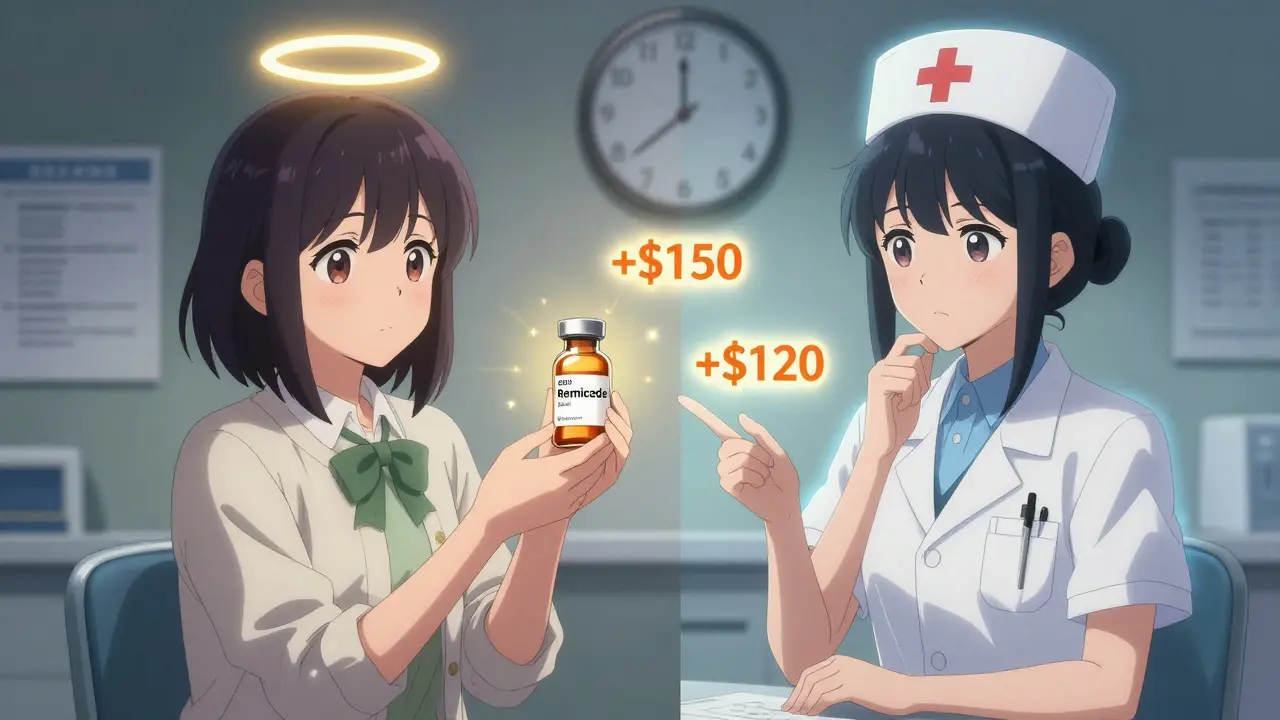
A 2020 analysis by MIT’s Dr. Mark Trusheim found that for every dose of Remicade, providers earn $150 in add-on revenue. For Inflectra, they earn $120. That $30 difference adds up fast-especially in clinics treating hundreds of patients a month. One oncology center reported that even with a 20% price discount, Inflectra utilization stayed under 25% for years.
What Happens When Claims Get Denied
Billing errors are common, especially during the transition to individual codes. A 2022 survey of 217 cancer centers found that 68% had billing confusion after the 2018 coding change. Forty-two percent experienced claim denials in the first six months. The most frequent mistakes? Using the wrong HCPCS code or forgetting the JZ modifier.Providers now rely on updated CMS drug pricing files, which are published quarterly. But many still use outdated codes-22% of initial denials come from this alone. Successful practices use dual verification: pharmacy staff confirm the product given, and billing staff cross-check the code before submission. This cuts error rates from 12-15% down to under 3%.
Some manufacturers, like Fresenius Kabi, now offer free coding guides with up-to-date HCPCS codes and modifier instructions. In a 2023 survey, 87% of providers said these guides helped reduce errors.

What’s Next for Biosimilar Reimbursement?
There’s growing pressure to fix the system. The Medicare Payment Advisory Commission (MedPAC) has proposed a "consolidated billing" model: instead of paying each biosimilar separately, Medicare would pay 106% of the volume-weighted average price of all drugs in the class. That’s called a Least Costly Alternative (LCA) payment. Under this system, if three biosimilars are on the market, the payment would be based on the average of all their prices, not the reference product’s.If adopted, this could boost biosimilar use by 15-20 percentage points, according to Avalere Health. It would also save Medicare billions. The Congressional Budget Office estimates that full LCA implementation could save $3.2 billion over 10 years.
CMS is currently reviewing options. In February 2023, they issued a notice asking for feedback on alternatives to the current 6% add-on structure-like a fixed-dollar payment or removing the reference product’s ASP from the biosimilar calculation entirely.
For now, the system remains complex. But with 32 FDA-approved biosimilars on the market as of late 2023 and the market expected to hit $15 billion by 2027, pressure to simplify and incentivize use will only grow.
What Providers Need to Do Today
If you’re a provider billing for biosimilars, here’s what you need to do right now:- Use the correct HCPCS code for the exact biosimilar administered. Don’t assume all infliximab biosimilars use the same code.
- Check CMS’s quarterly Physician Fee Schedule for updated pricing. Codes and rates change every three months.
- Apply the JZ modifier only when no drug is discarded from the vial.
- Verify the product with pharmacy staff before submitting the claim.
- Keep manufacturer coding guides on hand-they’re often more practical than CMS’s technical documents.
Training staff takes 40-60 hours per practice, but it’s worth it. Practices that invest in clear processes see fewer denials, faster payments, and better patient access to lower-cost drugs.
Why This Matters for Patients
Biosimilars aren’t just cheaper for Medicare-they’re cheaper for patients too. Lower provider reimbursement often translates to lower out-of-pocket costs, especially under Medicare Advantage plans. But if providers don’t use biosimilars because the payment doesn’t incentivize it, patients won’t benefit.Right now, the system rewards complexity over savings. Until reimbursement aligns with the goal of lowering costs-rather than preserving margins-biosimilars will keep fighting an uphill battle in the U.S. market. The technology exists. The science is solid. The question is whether the payment system will catch up.
How is biosimilar reimbursement different from generic drug reimbursement?
Generic drugs all share one HCPCS code and are paid at 100% of their ASP with no add-on. Biosimilars each have their own unique code and are paid at 100% of their ASP plus 6% of the reference product’s ASP. This means even if a biosimilar is cheaper, the provider’s reimbursement isn’t reduced proportionally.
Why do providers sometimes choose the more expensive reference product over a biosimilar?
Because Medicare pays providers 6% of the reference product’s ASP as an add-on. If the reference product costs $2,500 and the biosimilar costs $2,000, the provider earns $150 in add-on revenue for the reference product versus $120 for the biosimilar. That $30 difference adds up over time and can influence prescribing habits.
What is the JZ modifier and when is it required?
The JZ modifier is required on claims for infliximab and its biosimilars when the entire vial is used and no drug is discarded. If a provider opens a vial and uses all of it, they must add JZ to the claim. If any drug is thrown away, the modifier is not needed. This rule went into effect on July 1, 2023.
How often are biosimilar payment rates updated?
CMS updates biosimilar payment rates quarterly, based on the most recent Average Selling Price (ASP) data. The updated rates are published in the Medicare Physician Fee Schedule and take effect on January 1, April 1, July 1, and October 1 each year.
Do Medicare Advantage plans pay the same as traditional Medicare for biosimilars?
No. Traditional Medicare Part B pays 106% of ASP for biosimilars. Medicare Advantage plans often pay less-typically 100% to 103% of ASP-and sometimes negotiate different rates with providers. Patients may face higher out-of-pocket costs depending on their plan’s formulary and reimbursement rules.
What percentage of U.S. biosimilar use is covered by Medicare Part B?
Medicare Part B covers an estimated 65% of all biosimilar administrations in the U.S., primarily for drugs given in doctors’ offices and outpatient clinics. The rest are covered by private insurance, Medicaid, or other programs.
Is there a chance Medicare will change how it pays for biosimilars soon?
Yes. CMS is actively evaluating alternatives, including eliminating the reference product’s ASP from the biosimilar payment formula or switching to a consolidated payment based on the average price of all drugs in the class. MedPAC has recommended this change, and public comments are under review. A policy shift could happen as early as 2025.
Providers who understand these rules can help patients access affordable treatments. Those who don’t risk claim denials, lost revenue, and missed opportunities to reduce healthcare costs.
Anna Weitz
So the system literally pays doctors to keep using the expensive drug because the 6% add-on is tied to the brand not the biosimilar